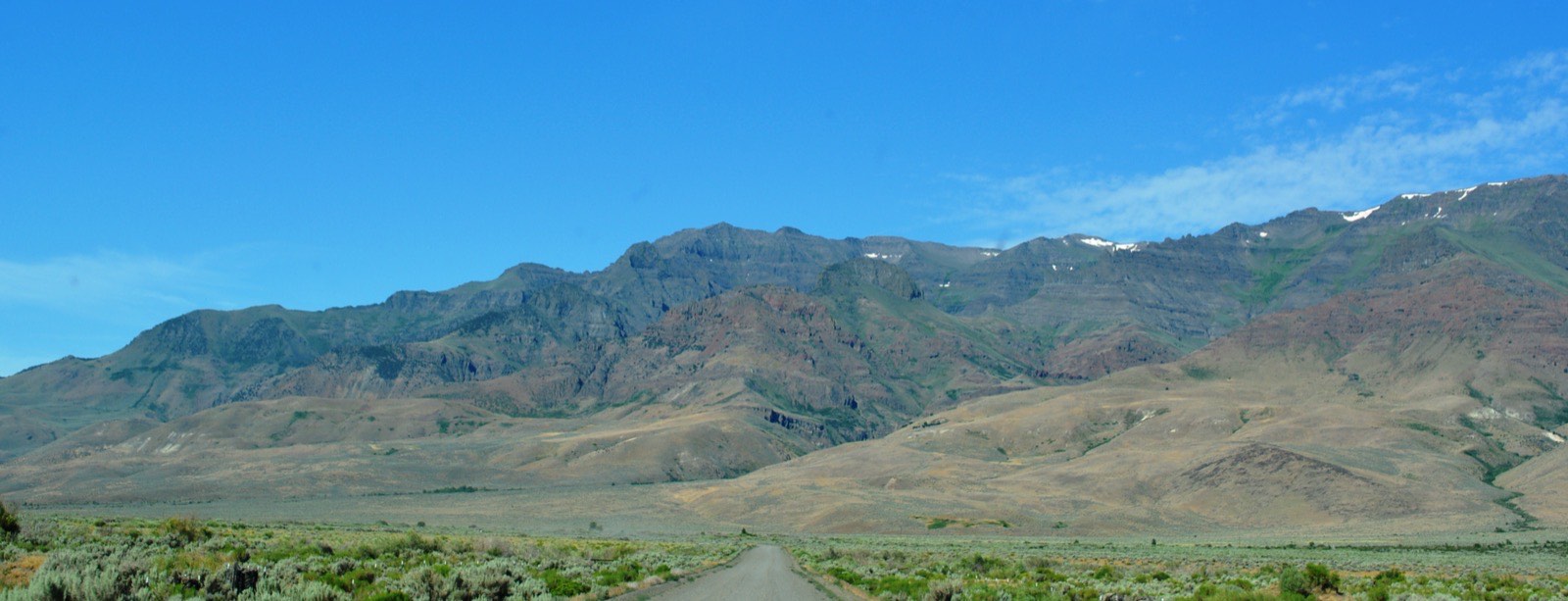
Independent economic studies for the ranches, tribal enterprises, and governments of Harney County, built on the county's own federal data and designed to hold up when a lender or a funder reviews them.
| Largest sectors by employment | Jobs | Concentration |
|---|---|---|
| Public administration | 458 | 3.53x |
| Health care & social assistance | 445 | 1.12x |
| Retail trade | 377 | 1.41x |
| Accommodation & food services | 288 | 1.2x |
| Educational services | 273 | 1.23x |
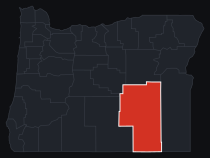
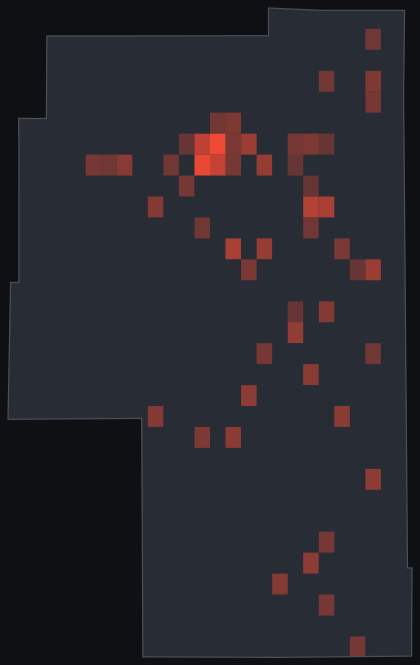
Source: U.S. Bureau of Labor Statistics, Quarterly Census of Employment and Wages, 2023 annual averages, Harney County. Concentration is a location quotient (county sector share of employment divided by the national share), computed by Project Red Team. Covered jobs exclude the self-employed and some agricultural workers.
Harney County runs on roughly 2,620 covered jobs across 368 establishments, at an average annual wage of $46,923, one of the lowest in the state, and the job count declined 2.4 percent over the most recent year on record. Public administration is the single largest line of work at 458 jobs, ahead of health care, retail, hospitality, and education, an ordering that reflects the map as much as the market: the Bureau of Land Management, the U.S. Fish and Wildlife Service, and county government sit over most of the county's land, so the government itself is the largest employer. Headcount still is not where Harney concentrates hardest. Agriculture, forestry, and fishing employ people here at more than twelve times the national rate, a level of specialization well beyond ordinary ranching counties, and it is why cattle, hay, and grazing leases, more than any payroll count, are the real center of gravity for anything built here.
Harney County is the largest county in Oregon by land area and one of the most sparsely populated in the country, a high-desert ranching economy built around Burns and Hines, with cattle, hay, and grazing leases as its productive core. Roaring Springs Ranch, immediately south of Frenchglen, runs a cow-calf and stocker cattle operation across roughly 1.2 million acres of owned and leased range, one of the largest such operations in the American West, and outfits like it set the pattern for the county rather than standing apart from it. The Bureau of Land Management and the U.S. Fish and Wildlife Service, which manages the Malheur National Wildlife Refuge, administer most of the county's land, which is also why the Burns Paiute Tribe's own economic future runs through land and enterprise: the Tribe is now standing up Wa Da' Holding LLC, a business development corporation meant to finally give tribal enterprise, cultural tourism, and land value a working vehicle.
A ranch expansion, a hay or livestock processing investment, a tribal enterprise, or a rural business seeking USDA financing all turn on the same two questions here: what it genuinely returns to a county this small, and whether it pencils under Harney's real conditions, including distances measured in hours, a thin local labor pool, and county and tribal budgets that lean on grant awards more than on local revenue.
The venture worth an honest look is the Burns Paiute Tribe's push to finally stand up Wa Da' Holding LLC, the tribally owned business development corporation the Tribal Council authorized by resolution in 2023 and is now working, through a 2025 request for proposals, to actually build out. The Tribe has wanted an enterprise arm for close to two decades to pursue cultural tourism, entrepreneurship, and the value of its own land, and it now has the legal structure to do it. What it does not yet have, before council time and tribal capital go into a first enterprise, is an independent, numbers-first answer to what a given venture would actually return in jobs and revenue for a workforce and tax base this small, and what it would take to make the financing work under Harney County's real cost structure. That is exactly the study a business development corporation needs before its first project, and the same discipline a USDA lender or a grant reviewer will expect to see behind it.
Public-data path: regional input-output multipliers, free-data regionalized or drawn from a purchased BEA RIMS II order where a project supplies one, BLS QCEW for the local labor base, USDA NASS for the cattle and hay operations that anchor the county, BLM and U.S. Fish and Wildlife Service land and grazing records for the public-land baseline, and the Burns Paiute Tribe's own economic development strategic plan and Wa Da' Holding LLC formation filings for the tribal enterprise picture.
We produce the study first: economic impact (what a project brings to Harney County, in jobs, output, and tax revenue, with local leakage handled honestly), feasibility and viability (whether it should move forward, measured with the finance a lender runs), and fiscal impact for public budgets and grant applications. Every engagement returns a full report, a one-page brief, a reviewer pack, and a decision package.
And if a study is already in hand, we review it: we inventory its quotable claims, attach the evidence, and tell you plainly what survives review before you quote it or fund against it. More on reading a study before you rely on it.
National firms fly in, bill the travel, and price a county like Harney out of the analysis it needs. We work across the interior West, we can be on-site in Burns, and we build every study on the county's measured federal record, the same BLS and Census data behind the numbers above, so the result traces to a public source and survives scrutiny.
Have a project in Harney County? Tell us what you are weighing and where. We will lay out what it takes to answer it, and what it costs.
Commission a study