PROJECT RED TEAM Commission a study
The evidence pack

Every claim on this site is backed by an artifact this engine generates.

Here are the artifacts. They are method demonstrations built from illustrative inputs, not findings about any real economy, and every release stamp you see on them is the engine's own. That is the point of showing them: a study service that has never refused anything is not exercising judgment.

One engine, three jobs

Produce a study, compare candidate sites, audit someone else's study.

The same engine does all three, and reports its own confidence honestly in each. Producing studies is analyst-led and ready today. Auditing an existing study is a strong first version with human review and source limits. Comparing candidate locations is early, and the ranking is withheld until it is stable.

Job one

Produce an economic-impact or feasibility study

The study is one solved object, and every surface below reads from it, so the report, the one-pager, and the reviewer pack cannot disagree with each other.
Study report
Preview of the the full analyst-led impact study

The full analyst-led impact study

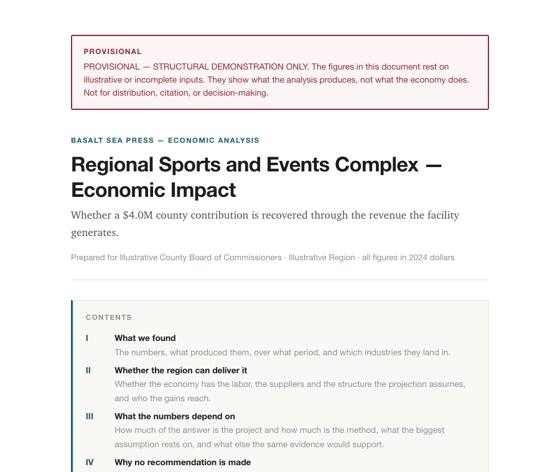
The complete study from one input file: construction and operations traced separately, a twelve-year horizon discounted to present value, a fiscal ledger by level of government, an industry breakdown, a read on who the wages reach, and a method appendix that names every source.

What it proves

That the engine renders a complete study end to end from a single input, defines the five words that are routinely misread upward, and labels construction figures as job-years rather than positions.

What it does not prove

Nothing about any real economy. The inputs are illustrative and the regional table is estimated rather than purchased. It does not prove forecast accuracy, and it withholds the recommendation.

Release status: Provisional, method demonstration only. The stamp is the engine's own, because the inputs are illustrative.
Open the study →
One-pager
Preview of the the board and council summary sheet

The board and council summary sheet

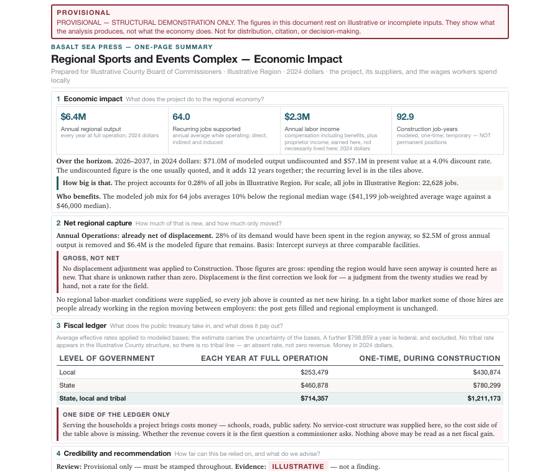
One sheet, four numbered cells: economic impact, net regional capture, the fiscal ledger, and credibility and recommendation. Written on the assumption it will be photographed and forwarded with the surrounding page cropped off.

What it proves

That a summary can compress without becoming a lie: every headline number carries its own qualifier in the same tile, and the fiscal cell states in the cell that revenue is not net.

What it does not prove

The same limits as the full report, and it does not stand alone as a decision document. Cell four says so rather than filling the space with a recommendation.

Release status: Provisional, method demonstration only.
Open the one-pager →
Reviewer pack
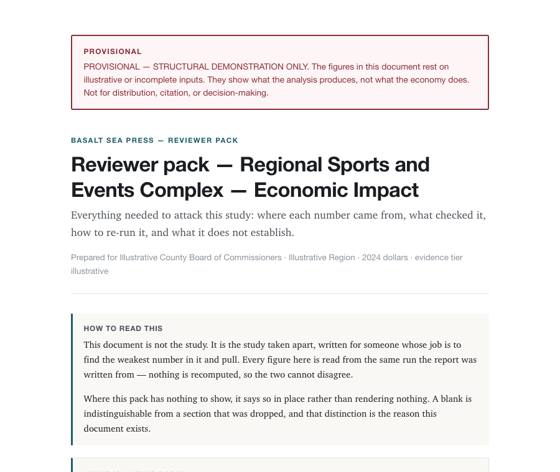
Preview of the the study taken apart for someone paid to attack it

The study taken apart for someone paid to attack it

The credibility ruling, every headline number traced to its formula and inputs, the validation register, the evidence base and what sets its floor, the commands to reproduce the run, and any part that was declared but not carried.

What it proves

That every number traces to a formula, an input, an evidence tier, and a validation result, all read from the same run the report was written from, so the two documents cannot disagree.

What it does not prove

That the arithmetic has been independently verified by a third party. It hands a reviewer what they need to do that; it does not do it for them.

Release status: Provisional, method demonstration only.
Open the reviewer pack →
Job two

Compare candidate sites across a corridor

The same project is scored at each candidate site through the same gates. The pack is designed to hand back a comparison even when it declines to name a winner.

Location pack
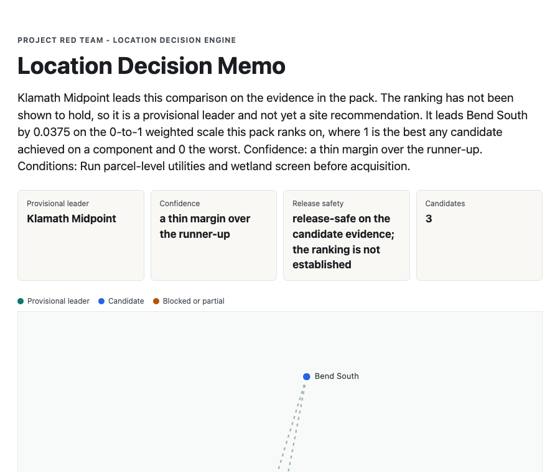
Preview of the an early comparison across candidate sites

An early comparison across candidate sites

A ranked table, a weighted score with its components, a candidate map, pairwise regret and win probability, the conditions attached to each candidate, and a release check.

What it proves

That the pack names a leading candidate and refuses to overstate it in the same breath: it labels the leader provisional, calls the confidence thin, and prints in plain language the condition that could flip the ranking.

What it does not prove

That the leading candidate is the right site. The candidates and scores are demonstration fixtures, the gap between first and second is smaller than the pack can resolve, and no parcel-level diligence is carried.

Release status: Release-safe, with the ranking not established. This is early corridor comparison, not a finished site-selection recommendation.

Board memo →Reviewer pack →Candidate map →
Job three

Audit someone else's existing study

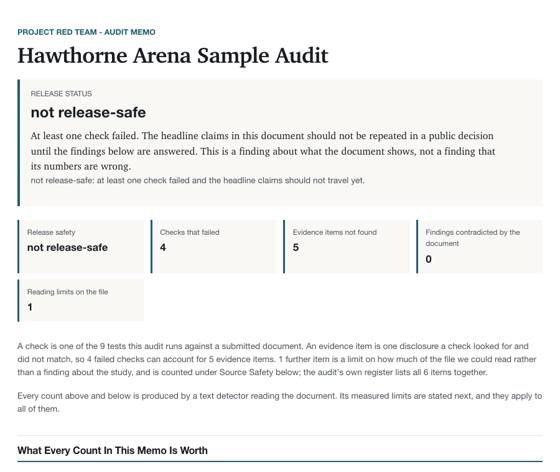
Send a study you did not commission and cannot check. The audit inventories what a reader would repeat, attaches the evidence it found, and makes the gaps first-class findings.

Audit pack
Preview of the our audit of someone else's impact study

Our audit of someone else's impact study

The standalone Audit Mode product. It reads a study as submitted and returns a board memo, a reviewer pack, a canonical audit JSON, a flat evidence surface, gate findings, missing-evidence findings, source status, the excerpt actually read, a release check, and a manifest with a checksum for every file.

What it proves

That the audit inventories the claims a reader would repeat, attaches whatever support it detected to each, runs named method gates, and turns the gaps into first-class findings rather than silence. The board memo leads with release status, then the reasons, each written as a question a board member would ask.

What it does not prove

That the audited study is wrong. It audits the document as submitted, does not re-run the model, and prints the detector's measured limits next to the counts. Every finding is a reason to ask a question, not a finding of error.

Release status: Not release-safe, and that is the finding: the headline claims should not be repeated in a public decision until the open gates are answered.

Board memo →Reviewer pack →Reviewer JSON →
Comparison-readiness pack
Preview of the a gate on comparing several studies

A gate on comparing several studies

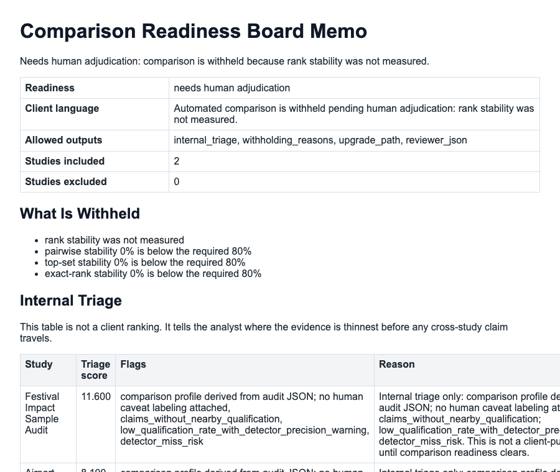
A cross-study comparison gate. It reads existing audit outputs and decides what comparison language may travel: exact rank, bands, internal triage only, or no client comparison.

What it proves

That comparison is treated as a gated claim rather than a charting option. The pack writes the internal work and then withholds client comparison language, because rank stability was not measured. The refusal is the product behavior.

What it does not prove

That either study is better, weaker, or more reliable than the other. The inputs are demonstration audit JSON, and the run does not supply the rank-stability evidence that exact order would require.

Release status: Release-safe refusal: the pack ships, and the client comparison inside it is withheld.

Board memo →Reviewer pack →
The refusal

A gate with more than one outcome.

One artifact in the buyer pack is a study the engine blocked outright. Its banner reads, in the engine's own words, "NOT FOR RELEASE. This document failed pre-publication review and must not be distributed, cited, or relied on." We do not post it here, because the document tells us not to distribute it, and honoring that is the whole point. It is the answer to the question a serious buyer asks first: what stops you from telling me what I want to hear. It is in the full pack on request.

What this pack does not prove

Stated here, rather than discovered later.

Want the full pack, or the same work on your project? Tell us what you are weighing, or send a study you need checked. We will lay out what it takes and what it costs.

Get in touch