The US-97 package shows how Project Red Team separates corridor-wide impact, location comparison, and viability review. It is being built now. A BEA RIMS II aggregate multiplier region has been ordered for the corridor, and the corridor artifacts will appear here as the engine generates them, each with its command, release stamp, and what it does and does not prove.
The flagship package brings four questions into one governed record: the corridor-wide economic impact, a location decision among candidate sites, comparison readiness against other studies, and a preliminary viability screen. Every figure will carry its source, its evidence tier, and its release ruling, and every missing input will be named rather than hidden.
The package treats these nine counties as one connected market region, from Weed and Mount Shasta up to the Columbia. See how corridor studies work.
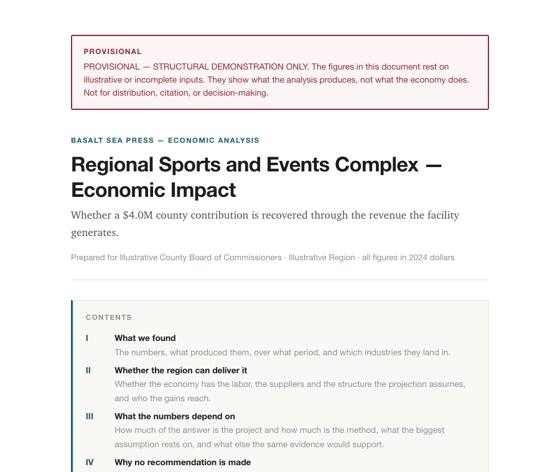
Project Red Team has ordered a BEA RIMS II multiplier region for the US-97 corridor: Type I and Type II multipliers, 2024 regional data on the 2017 national input-output accounts. When the files arrive, they strengthen the multiplier base the corridor-wide impact rests on, in place of a free-data estimate. The report will label which effects the purchased multipliers support and which remain free-data estimated.
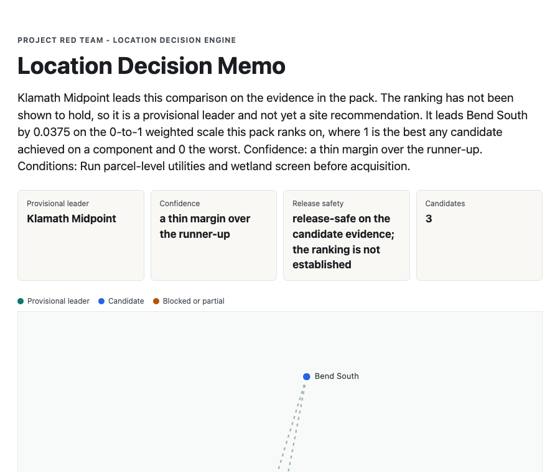
A location pack scores each candidate site through the same evidence gates, names a provisional leader, and measures how stable that lead is. It reports the margin, the components driving it, and the flip conditions that would change the order. The pack shows which candidate leads on the evidence supplied, and whether that lead is stable enough to become a recommendation. Until the stability math clears, it withholds any selected-site language and says so plainly.
The US-97 corridor packs are being generated. In the meantime, here are the same artifact types run on the sample inputs the engine ships with, so you can see the shape of what the corridor package will deliver. These are demonstrations on illustrative inputs, not findings about the corridor, and they carry the release stamps the engine assigned.
An early corridor comparison: a provisional leader, the margin, and the flip condition. Ranking withheld until it is stable.
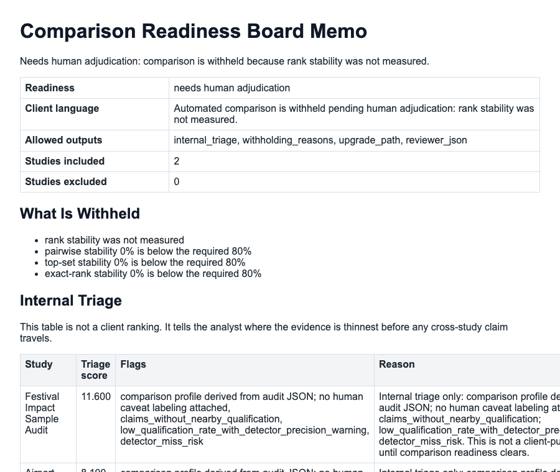
Open the artifact →A gate on comparing several studies: what may be ranked, what is withheld, and why.
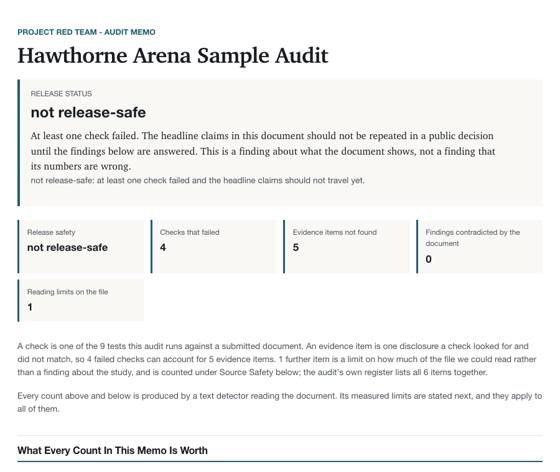
Open the artifact →Our audit of an outside study: claims inventoried, evidence attached, gaps named, and a plain not-release-safe ruling with what would close it.
Open the artifact →Before any figure is written, the engine checks the public data sources a study depends on and records each as live, cached, credential-required, failed, partial, not applicable, or not supplied. A missing input is turned into an evidence object and named in the pack, so the study begins from a governed scan rather than a blank assumptions page. The source-status record from the sample pack shows that scan in machine-readable form.
This is a preliminary viability screen against a submitted pro forma and the public source record. It does not yet replace a full feasibility study, and it is not a site recommendation. A person stands behind every conclusion, and the package states what it establishes and what it does not.
Weighing a project along the corridor? Tell us the project and the candidate sites, and we will lay out what a corridor study can settle now and what it cannot.
Get in touch