Independent economic studies for the ranchers, agencies, and businesses of Modoc County, built on the county's own federal data and designed to hold up when a lender or a funder reviews them.
| Largest sectors by employment | Jobs | Concentration |
|---|---|---|
| Public administration | 442 | 3.29x |
| Agriculture, forestry & fishing | 344 | 15.48x |
| Health care & social assistance | 257 | 0.62x |
| Educational services | 211 | 0.92x |
| Retail trade | 198 | 0.72x |
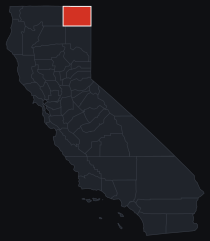
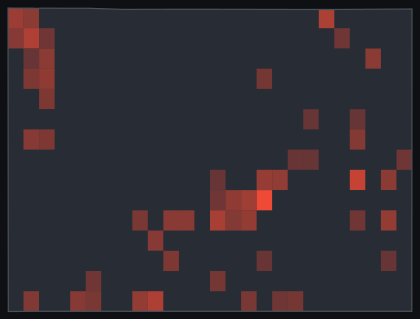
Source: U.S. Bureau of Labor Statistics, Quarterly Census of Employment and Wages, 2023 annual averages, Modoc County. Concentration is a location quotient (county sector share of employment divided by the national share), computed by Project Red Team. Covered jobs exclude the self-employed and some agricultural workers.
Modoc County runs on roughly 2,707 covered jobs across 406 establishments, at an average annual wage of $51,344, in a county small enough that a handful of jobs moves the numbers. Jobs grew 2.1 percent over the year. Public administration is the largest employer by headcount at 442 jobs, county and federal government work in a county where the Modoc National Forest and other public land cover most of the map, followed by agriculture, forestry, and fishing at 344 jobs, health care and social assistance at 257, educational services at 211, and retail trade at 198. The real story is concentration: agriculture, forestry, and fishing runs at 15.48 times the national rate, the single highest specialization of any county in this set, and by a wide margin. Public administration follows at 3.29 times the national rate. Nothing else comes close: other services sits at 1.29x and construction at 0.93x. A county this specialized in one sector does not get a second chance if a study gets the ag economics wrong.
Modoc County is the most rural corner of California outside a park boundary, roughly 8,500 people spread across more than four thousand square miles centered on Alturas, the county seat and the only incorporated city. The Modoc National Forest, headquartered in Alturas at more than 1.6 million acres, and other public land cover well over half the county, leaving a comparatively small private and irrigated base to carry an economy built almost entirely on cattle ranching and hay and alfalfa production. It is also Modoc homeland; the Modoc people were removed to the Klamath Reservation in Oregon after the 1872-73 war that bears their name, and the Modoc Tribe is enrolled within the Klamath Tribes today. The Pit River Tribe holds the Likely, Lookout, and XL Ranch rancherias in the county, alongside the Fort Bidwell Indian Community, the Alturas Indian Rancheria, and the Cedarville Rancheria. Public services here are genuinely sparse: one hospital, one incorporated city, and a county government that is itself one of the largest employers, which shows up directly in the public administration numbers above.
That leaves the county's economy resting on one leg. Agriculture is the only private sector here with real scale, which means a new ranch operation, a processing facility, or a USDA-backed loan for either one succeeds or fails largely on its own terms rather than against a field of alternatives, and the multiplier it generates locally, in feed, hauling, veterinary services, trucking, and equipment, touches nearly the entire local private economy rather than one slice of it. That is the frame every study in Modoc County has to start from.
The build most worth an impact study is the meat processing plant Superior California Economic Development and the City of Alturas are trying to get built on a city-owned site southwest of town. The region runs roughly 60,000 head of calves a year through ranches that ship the cattle out of the county for finishing and processing, and a USDA-certified plant designed for full slaughter and cut-and-wrap service, with added capacity for lamb, pork, goat, and game, would let some of that value stay local instead of leaving with the trucks. A feasibility study is already done and the project is now in investor recruitment, with roughly $4.2 million in equipment, $1.7 million in site development, and $400,000 in operating capital still to raise, and 5 to 7 full-time jobs projected in year one. That is a modest jobs count by national standards and a real one for a county with 2,707 covered jobs total, and it is exactly the kind of project where a lender wants the jobs, payroll, and backward linkages into the county's dominant industry modeled honestly rather than assumed.
Public-data path: BLS QCEW for the local job and wage base, USDA NASS census of agriculture for the cattle and hay economy behind the ag concentration, regional input-output multipliers, free-data regionalized or drawn from a purchased BEA RIMS II order where a project supplies one, and the meat processing plant's own published feasibility study and USDA financing program terms for the candidate project above.
We produce the study first: economic impact (what a project brings to Modoc County, in jobs, output, and tax revenue, with local leakage handled honestly), feasibility and viability (whether it should move forward, measured with the finance a lender runs), and fiscal impact for public budgets and grant applications. Every engagement returns a full report, a one-page brief, a reviewer pack, and a decision package.
And if a study is already in hand, we review it: we inventory its quotable claims, attach the evidence, and tell you plainly what survives review before you quote it or fund against it. More on reading a study before you rely on it.
National firms fly in, bill the travel, and skip a county this small entirely, or price it out of the analysis it needs. We work across the interior West, we can be on-site in Alturas, and we build every study on the county's measured federal record, the same BLS and USDA data behind the numbers above, so the result traces to a public source and survives scrutiny from a lender or a funder.
Have a project in Modoc County? Tell us what you are weighing and where. We will lay out what it takes to answer it, and what it costs.
Commission a study