Independent economic studies for the governments, developers, and businesses of Siskiyou County, built on the county's own federal data and designed to hold up when a lender, a funder, or a tribal council reviews them.
| Largest sectors by employment | Jobs | Concentration |
|---|---|---|
| Health care & social assistance | 2,484 | 1.17x |
| Public administration | 1,700 | 2.45x |
| Retail trade | 1,596 | 1.12x |
| Educational services | 1,580 | 1.34x |
| Accommodation & food services | 1,512 | 1.18x |
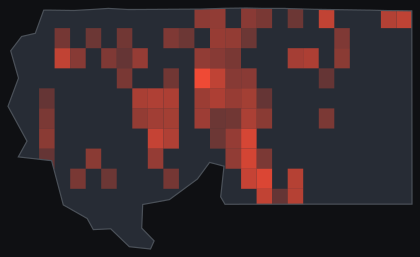
Source: U.S. Bureau of Labor Statistics, Quarterly Census of Employment and Wages, 2023 annual averages, Siskiyou County. Concentration is a location quotient (county sector share of employment divided by the national share), computed by Project Red Team. Covered jobs exclude the self-employed and some agricultural workers.
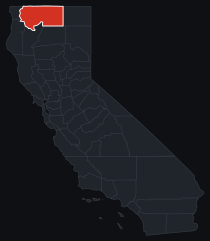
Siskiyou County runs on roughly 13,995 covered jobs across 1,813 establishments, at an average annual wage of $51,166, a figure that sits well below the national average and defines the kind of household budget a study here has to work with. Job growth was essentially flat over the year, up 0.6 percent, so a new project has to add real headcount rather than just reshuffle it. Health care and social assistance is the largest sector by employment at 2,484 jobs, followed by public administration at 1,700, retail trade at 1,596, educational services at 1,580, and accommodation and food services at 1,512, the ordinary mix of a rural hub county built around a hospital, a county seat, and a highway corridor. The real story is in concentration: public administration runs at 2.45 times the national rate, the highest specialization in the county, the direct result of a landscape where the Klamath, Shasta-Trinity, and three other national forests cover roughly 60 percent of the county's land base and the Klamath National Forest runs its entire operation out of Yreka. Arts, entertainment, and recreation follows at 1.77 times the national rate and utilities at 1.38 times, both traceable to the same geography: a county built for outdoor recreation that also carries the hydroelectric and transmission infrastructure of the Klamath River system.
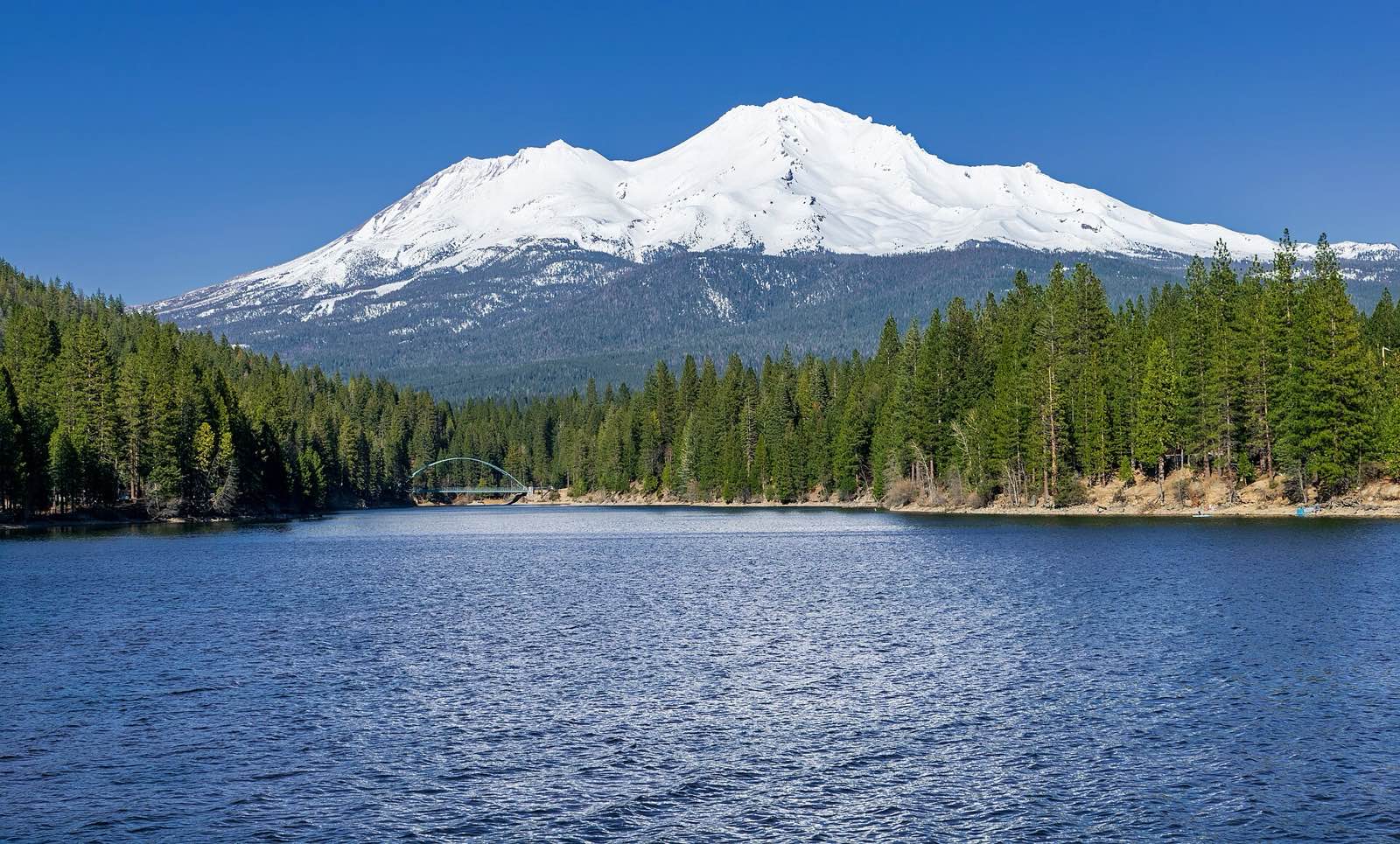
Siskiyou County's working economy sits on three legs that have all moved in the last two years. Agriculture is the steadiest: ranchers and growers in the Shasta, Scott, and Butte Valleys posted $386.6 million in gross agricultural receipts in 2021, built on cattle, hay, and a strawberry nursery-stock trade that ships planting stock worldwide. Timber has gone the other way. Roseburg Forest Products closed its veneer plant in Weed in late 2025, cutting roughly 140 jobs in a county where wood products once anchored entire towns, and the mill site now sits as an open question for whatever comes next. Tourism is the growth leg: Mount Shasta itself, the ski park on its flank, the Pacific Crest Trail, and the whitewater and camping economy along the Klamath and Sacramento River corridors keep the county's arts, entertainment, and recreation sector running well above the national rate, drawing visitors through Yreka, Mount Shasta City, and Dunsmuir along the I-5 corridor.
The county is also where the largest dam removal project in United States history actually happened on the ground: Iron Gate, Copco No. 1, and Copco No. 2, the three lower dams on the Klamath River, all sat inside Siskiyou County, and their removal in 2023 and 2024 freed the river from Upper Klamath Lake to the Pacific. California is now returning roughly 2,800 acres of the exposed reservoir land to the Shasta Indian Nation, the largest land return in the state's history, alongside a longstanding Karuk Tribe presence centered in Happy Camp and Yreka and the Quartz Valley Indian Reservation in Scott Valley. Rural health care is its own live question: Fairchild Medical Center in Yreka, the county's only Critical Access Hospital, is in the middle of a $42 million expansion, adding a 22,800-square-foot wing for its emergency and laboratory departments and financed in part with $8 million in federal New Markets Tax Credits, because a hospital this size in a county this rural has to make a public case for capital it cannot raise any other way.
The strongest candidate for a full economic-impact study here is the Fairchild Medical Center expansion. A federally designated Critical Access Hospital adding a new emergency and laboratory wing is exactly the kind of project a funder, a county board, or the hospital's own capital campaign eventually needs modeled properly: the construction spending through the project's 2027 completion, the new clinical and support staff a larger footprint requires, and the payroll and downstream local spending those hires bring to a county where health care already accounts for more jobs than any other sector. The harder number, the one a press release never runs, is what the expansion is worth in retained care, the money Siskiyou residents currently spend on gas, lodging, and specialist visits in Medford or Redding because Fairchild can't handle a case locally, and how much of that spending a bigger ER and lab actually pulls back into the county. That is a number built on New Markets Tax Credit reporting requirements, CMS hospital cost report data, and the hospital's own service-area figures, not a guess.
Public-data path: BLS QCEW and Census LODES for the local labor base, USDA NASS and the Siskiyou County Agricultural Commissioner's crop and livestock reports for the agricultural core, CDFI Fund New Markets Tax Credit allocation records and CMS hospital cost reports for the Fairchild Medical Center expansion, and the public restoration and land-transfer filings from the Klamath River Renewal Corporation and the California Natural Resources Agency for the dam-removal and land-return activity in the county.
We produce the study first: economic impact (what a project brings to Siskiyou County, in jobs, output, and tax revenue, with local leakage handled honestly), feasibility and viability (whether it should move forward, measured with the finance a lender runs), and fiscal impact for public budgets and grant applications. Every engagement returns a full report, a one-page brief, a reviewer pack, and a decision package.
And if a study is already in hand, we review it: we inventory its quotable claims, attach the evidence, and tell you plainly what survives review before you quote it or fund against it. More on reading a study before you rely on it.
National firms fly in, bill the travel, and price a county like Siskiyou out of the analysis it needs. We work across the interior West, we can be on-site in Yreka or Mount Shasta, and we build every study on the county's measured federal record, the same BLS and Census data behind the numbers above, so the result traces to a public source and survives scrutiny.
Have a project in Siskiyou County? Tell us what you are weighing and where. We will lay out what it takes to answer it, and what it costs.
Commission a study