The economic impact of a sawmill or forestry project
Wood products still anchor rural economies across the interior West. What an honest sawmill or forestry study measures, and where the local dollars really are.
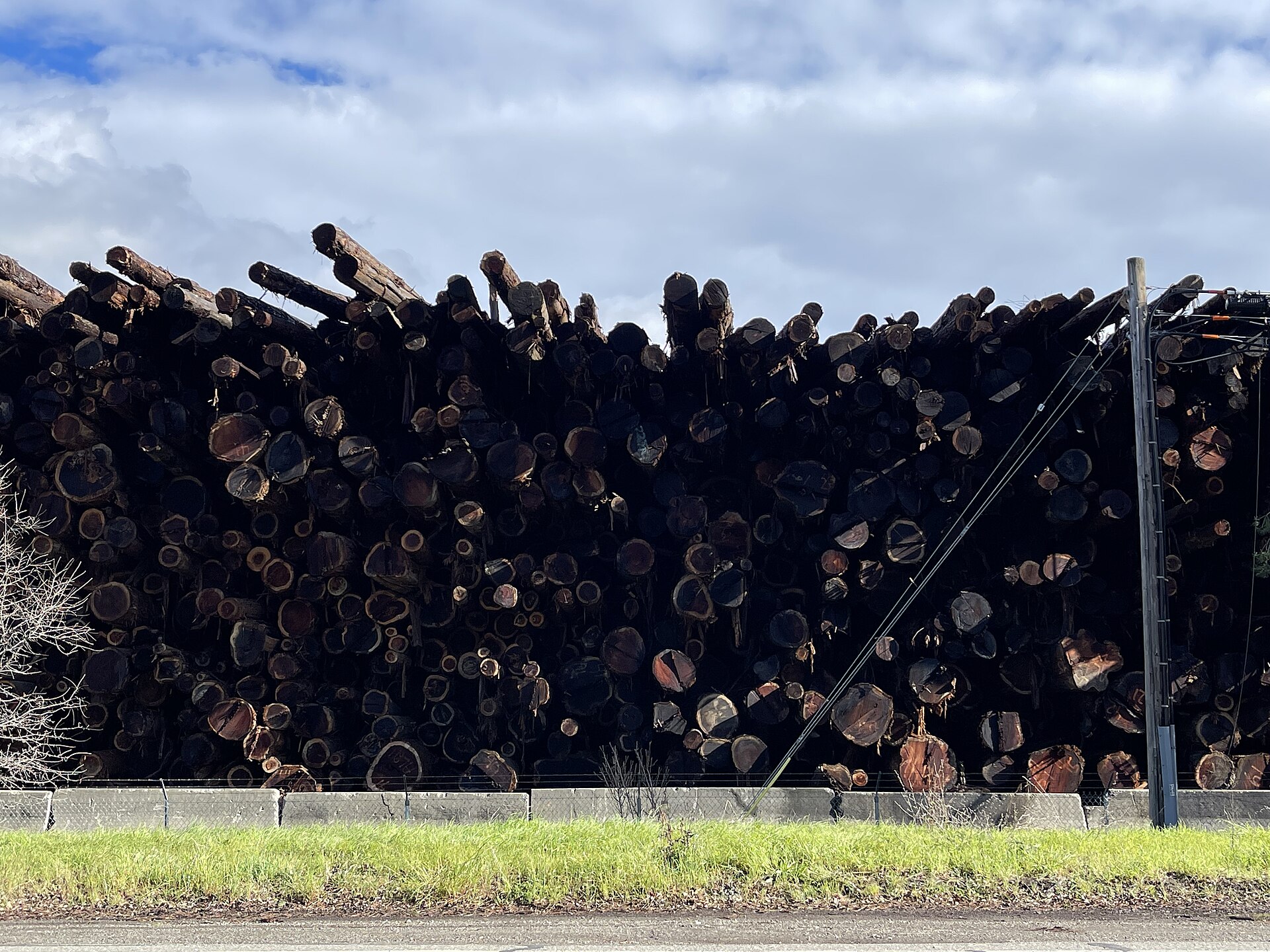
Stacked logs at a working sawmill yard. Photo: Missvain, CC BY 4.0. Source
The impact rides on the local supply chain. Ask whether the timber, logging, and hauling are sourced nearby, and how secure the log supply is over time.
An industry that recirculates locally
Wood products remain a backbone of many rural economies across the interior West, and a sawmill or forestry operation tends to keep more of its dollars in the region than a project that imports its inputs. The timber comes from nearby land, the logging and hauling are done by local contractors, and the payroll lands in small towns that have few other large employers. That local supply chain is what makes forestry impacts real, and it is the part a good study takes the time to trace.
Following the timber dollar
The strength of a forestry impact is the length of the local supply chain: the landowner or agency selling the timber, the crews that harvest it, the truckers who move it, the mill that processes it, and the workers throughout. Each link that stays in the region multiplies the original dollar further. A sound study maps that chain rather than assuming it, because the multiplier for wood products depends heavily on how much of the chain is genuinely local.
Where the leakage is
Not everything stays. Major equipment, some processing inputs, and the eventual sale of finished lumber to distant markets send dollars out of the region. That is normal for a producing industry and belongs in the analysis. The honest number credits the region with the local harvesting, hauling, milling, and payroll, and does not claim the full value of lumber sold to another state as a local gain.
Supply, and whether it lasts
A mill is only as durable as its timber supply, and in this region that supply depends on federal and state land management, forest health, and fire. A serious feasibility or impact study for a forestry project has to look at whether the resource can sustain the operation over its planned life, because a mill built on a supply that will not hold is a short story with a hard ending. Ignoring the supply question is the fastest way to overstate a forestry project's future.
The fiscal and community picture
For the towns that host them, mills and forestry operations carry weight beyond the payroll: they anchor a tax base, support schools, and hold a working culture in place. A study can note that plainly while keeping it separate from the market impact, so a county sees both the economic footprint and what the operation means to the community around it.
What a defensible forestry study looks like
It traces the local supply chain instead of assuming it, credits only the dollars that stay in the region, tests whether the timber supply can last, and shows the fiscal and community picture honestly. Done that way, a sawmill or forestry study reflects an industry that, when the supply holds, keeps more of its value at home than almost anything else a rural county can build.
Weighing a project like this? Tell us what you are planning and where, and we will lay out what a defensible impact and feasibility read takes, and what it costs.
Start a conversation