Independent economic studies for the governments, developers, and businesses of Josephine County, built on the county's own federal data and designed to hold up when a lender, a funder, or a county budget officer reviews them.
| Largest sectors by employment | Jobs | Concentration |
|---|---|---|
| Health care & social assistance | 9,385 | 1.99x |
| Retail trade | 4,178 | 1.32x |
| Accommodation & food services | 3,152 | 1.11x |
| Manufacturing | 2,935 | 1.12x |
| Construction | 1,294 | 0.79x |
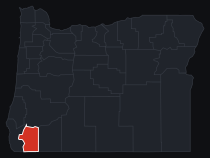
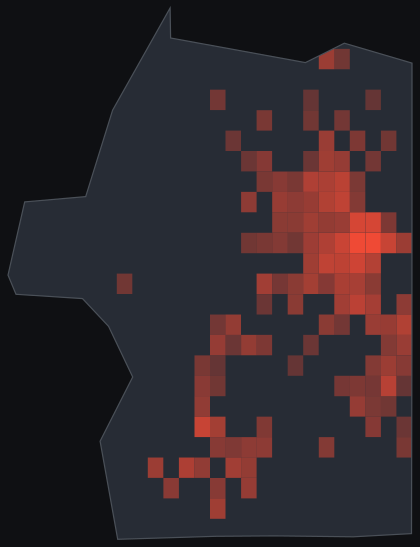
Source: U.S. Bureau of Labor Statistics, Quarterly Census of Employment and Wages, 2023 annual averages, Josephine County. Concentration is a location quotient (county sector share of employment divided by the national share), computed by Project Red Team. Covered jobs exclude the self-employed and some agricultural workers.
Josephine County runs on roughly 31,017 covered jobs across 2,915 establishments, at an average annual wage of $47,703, well below the national average and consistent with a county whose work is mostly service work rather than production. Employment grew 3.7 percent over the year, a real and recent gain. Health care and social assistance is the largest employer by a wide margin, at 9,385 jobs, and it is also the county's most concentrated sector at nearly twice the national employment share (LQ 1.99), anchored by Three Rivers Medical Center in Grants Pass. Retail trade follows at 4,178 jobs (LQ 1.32), accommodation and food services at 3,152 jobs (LQ 1.11), and manufacturing, the shrunken remnant of what was once a much larger timber economy, at 2,935 jobs (LQ 1.12). Construction, at 1,294 jobs, runs below the national rate (LQ 0.79). The pattern is a county built on caring for people, selling to them, and hosting visitors, more than one built on making or building things, and any project here has to be judged against that real labor market, not an assumed one.
Josephine County sits where the Rogue and Applegate rivers meet, and it still carries the outline of the timber economy that once defined it: sawmills and wood products plants ran from Grants Pass to Cave Junction for most of a century, and the last of them, Rough & Ready Lumber, closed for good in 2016 after repeated attempts to keep it running. What has grown into that space is health care, retail, and tourism: Three Rivers Medical Center in Grants Pass is the county's largest employer, more than two dozen outfitters run whitewater trips on the Rogue every summer, and licensed cannabis cultivation, concentrated in the Illinois Valley, has become a real if uneven piece of the county's agricultural base.
The harder fact underneath all of it is the county's tax structure. Josephine County has the lowest permanent property tax rate of any county in Oregon, fixed in the 1990s when the state's tax measures locked local rates in place, and for decades the gap was covered by federal O&C timber payments tied to the county's own public forestland. Those payments were sharply cut after 2012, and the county has funded its jail and much of its law enforcement on renewable local option levies ever since, a structural condition every project sponsor and every public agency here has to plan around, whether the question is a new facility's tax contribution or the county's own capacity to fund the services around it.
The fiscal question in front of voters is the Adult Jail and Juvenile Detention levy renewal on the November 3, 2026 ballot, a five-year, $0.93-per-$1,000 local option tax that keeps the county's 185-bed jail staffed and open. Josephine County has run its jail on renewable levies like this one ever since the federal O&C timber payments that used to backstop county government were cut after 2012, and the levy has to be renewed or the capacity goes away. A fiscal impact study here is not a private development pro forma; it is pricing what jail capacity, patrol coverage, and juvenile detention are actually worth to the county's economy and its liability exposure, and what a lapse would cost against what the levy costs taxpayers. That is exactly the kind of question the engine is built to answer, with citations that hold up in a ballot debate.
Public-data path: BLS QCEW and Census LODES for the county's labor base, regional input-output multipliers, free-data regionalized or drawn from a purchased BEA RIMS II order where a project supplies one, Oregon Department of Revenue records for the county's assessed value and permanent rate history, and the levy language, fiscal notes, and jail staffing figures published by Josephine County and the Josephine County Sheriff's Office.
We produce the study first: economic impact (what a project brings to Josephine County, in jobs, output, and tax revenue, with local leakage handled honestly), feasibility and viability (whether it should move forward, measured with the finance a lender runs), and fiscal impact for public budgets and grant applications. Every engagement returns a full report, a one-page brief, a reviewer pack, and a decision package.
And if a study is already in hand, we review it: we inventory its quotable claims, attach the evidence, and tell you plainly what survives review before you quote it or fund against it. More on reading a study before you rely on it.
National firms fly in, bill the travel, and price a county like Josephine out of the analysis it needs, especially when the client is a small city, a special district, or a sheriff's office running on a levy. We work across the interior West, we can be on-site in Grants Pass, and we build every study on the county's measured federal record, the same BLS and Census data behind the numbers above, so the result traces to a public source and survives scrutiny at the ballot box or the loan committee table.
Have a project in Josephine County? Tell us what you are weighing and where. We will lay out what it takes to answer it, and what it costs.
Commission a study