
Independent economic studies for the governments, developers, and businesses of the Umpqua Valley, built on Douglas County's own federal data and designed to hold up when a lender or a funder reviews them.
| Largest sectors by employment | Jobs | Concentration |
|---|---|---|
| Health care & social assistance | 7,682 | 1.31x |
| Retail trade | 4,857 | 1.23x |
| Manufacturing | 4,598 | 1.41x |
| Accommodation & food services | 3,412 | 0.96x |
| Public administration | 2,017 | 1.05x |
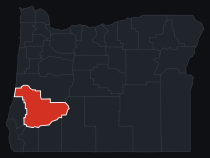
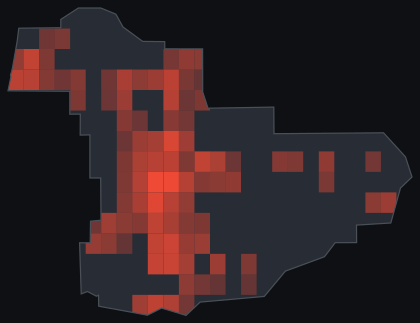
Source: U.S. Bureau of Labor Statistics, Quarterly Census of Employment and Wages, 2023 annual averages, Douglas County. Concentration is a location quotient (county sector share of employment divided by the national share), computed by Project Red Team. Covered jobs exclude the self-employed and some agricultural workers.
Douglas County runs on roughly 38,662 covered jobs across about 3,692 establishments, at an average annual wage of $51,081, with employment essentially flat over the year at plus 0.5 percent. Health care and social assistance is the largest sector at 7,682 jobs, followed by retail trade, manufacturing, accommodation and food services, and public administration, the ordinary spine of a rural county anchored by one regional hospital town. The concentration numbers point somewhere else: agriculture, forestry, and fishing employ people here at 5.29 times the national rate, by far the sharpest specialization in the county, and manufacturing, most of it built around wood products, still runs 1.41 times the national share. Health care has the bigger headcount now, but the forest is still what the county is built on top of, and it is why a sawmill or wood-products project here carries weight the raw jobs number alone would not suggest.
Douglas County was built on timber. Roseburg called itself the Timber Capital of the Nation in the postwar decades, when the county ran close to 280 sawmills, and the 1990s cutback in federal timber sales hit here as hard as anywhere in Oregon, with county unemployment climbing into double digits before the region rebuilt around health care, retail, and a smaller, more consolidated wood-products base. Roseburg Forest Products remains the anchor employer in that base, and Mercy Medical Center, the county's regional hospital, now stands alongside it as one of the largest employers in Roseburg. Wine is the newer layer: the Umpqua Valley AVA, one of Oregon's oldest wine-growing regions, now carries more than thirty wineries, including Abacela, the first winery in the country to plant Albariño and the first in the Pacific Northwest to commercially grow Tempranillo.
A wood-products expansion, a manufacturing plant, a hospital or health-system investment, or a winery or agritourism venture here all turn on the same two questions: what the project actually returns to a county that has watched timber promises come and go for three decades, and whether it pencils under Douglas County's real labor and wage conditions, not the version in a developer's own deck.
The project a study could model next is Roseburg Forest Products' Dillard MDF and Dillard Components project, a $700 million buildout of two new wood-products plants outside Roseburg announced in 2023, at the time one of the largest private manufacturing investments in rural Oregon history. The company paused construction in early 2025 over market conditions and Oregon policy uncertainty, then restarted it in March 2026, with the MDF plant now targeted to begin operating in late 2028 and expected to employ more than 140 people. That pause and restart is itself the case study: separating a genuine $700 million commitment from the announcement of one, and pricing what three years of delay cost the county in the meantime, is exactly the kind of question the engine is built to answer.
Public-data path: regional input-output multipliers, free-data regionalized or drawn from a purchased BEA RIMS II order where a project supplies one, BLS QCEW and Census LODES for the local labor base, Oregon Employment Department data on the wood-products sector, and the investment figures and construction timeline Roseburg Forest Products has disclosed in its own announcements and to local press.
We produce the study first: economic impact (what a project brings to Douglas County, in jobs, output, and tax revenue, with local leakage handled honestly), feasibility and viability (whether it should move forward, measured with the finance a lender runs), and fiscal impact for public budgets and grant applications. Every engagement returns a full report, a one-page brief, a reviewer pack, and a decision package.
And if a study is already in hand, we review it: we inventory its quotable claims, attach the evidence, and tell you plainly what survives review before you quote it or fund against it. More on reading a study before you rely on it.
National firms fly in, bill the travel, and price a county like Douglas out of the analysis it needs. We work across the interior West and southern Oregon, we can be on-site, and we build every study on the county's measured federal record, the same BLS and Census data behind the numbers above, so the result traces to a public source and survives scrutiny.
Have a project in Douglas County? Tell us what you are weighing and where. We will lay out what it takes to answer it, and what it costs.
Commission a study