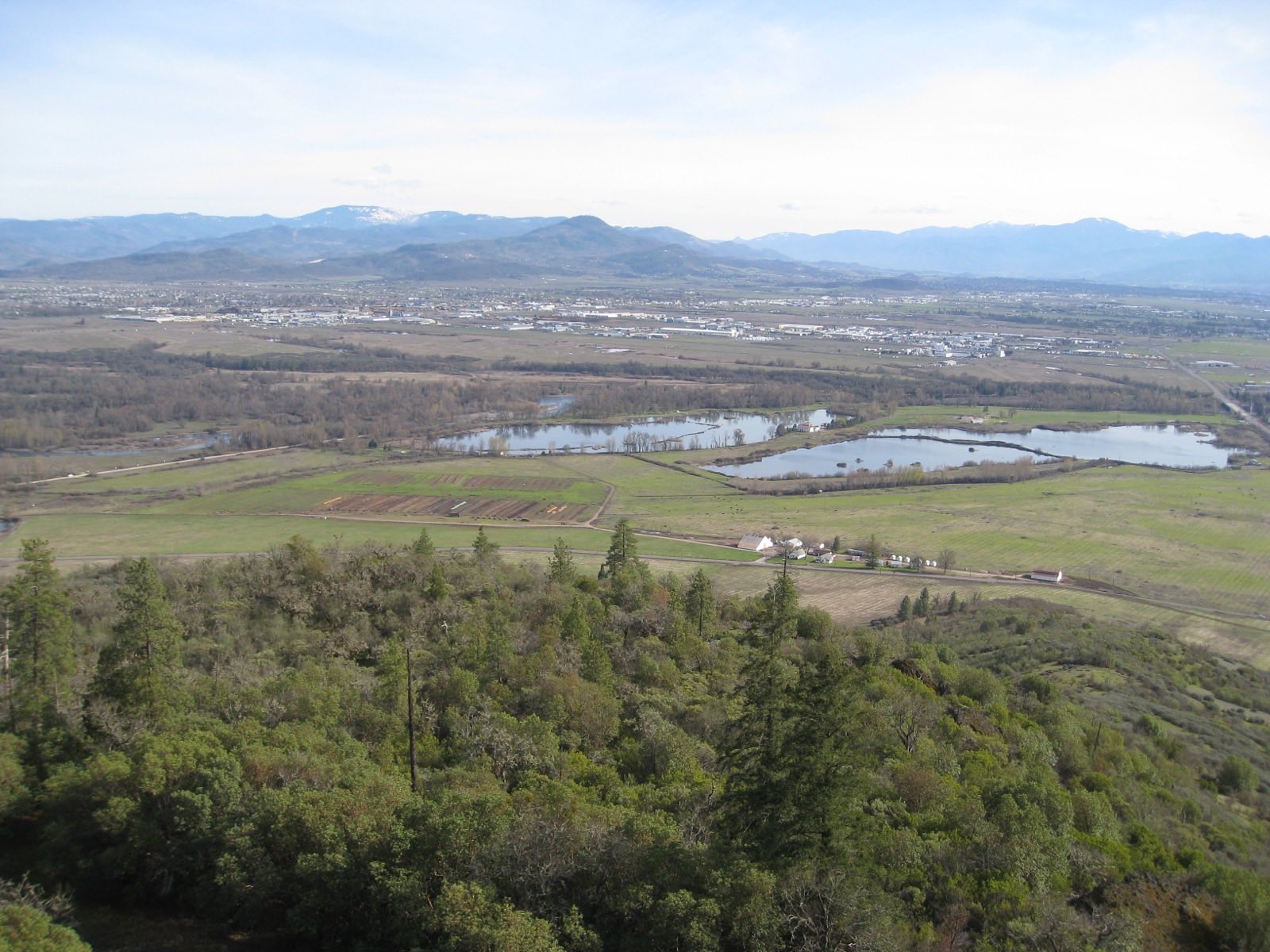
Independent economic studies for the governments, developers, and businesses of the Rogue Valley, built on Jackson County's own federal data and designed to hold up when a lender or a funder reviews them.
| Largest sectors by employment | Jobs | Concentration |
|---|---|---|
| Health care & social assistance | 18,909 | 1.37x |
| Retail trade | 13,530 | 1.46x |
| Accommodation & food services | 9,196 | 1.1x |
| Manufacturing | 7,054 | 0.92x |
| Construction | 5,834 | 1.21x |
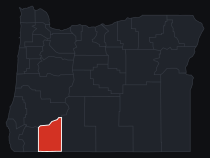
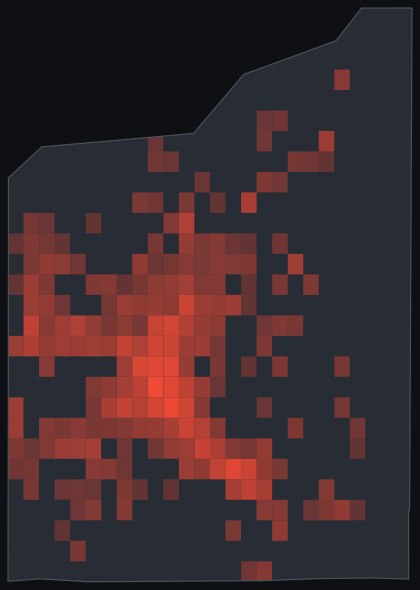
Source: U.S. Bureau of Labor Statistics, Quarterly Census of Employment and Wages, 2023 annual averages, Jackson County. Concentration is a location quotient (county sector share of employment divided by the national share), computed by Project Red Team. Covered jobs exclude the self-employed and some agricultural workers.
Jackson County runs on 91,044 covered jobs across 8,785 establishments, at an average annual wage of $55,856, well above the wage in most of rural Oregon and a sign of how much of this economy sits in hospitals, dealership offices, and food-manufacturing plants rather than in the fields alone. Employment grew 1.4 percent over the year, the kind of steady gain a mature regional hub posts rather than the swings of a boom county. Health care and social assistance is the largest sector outright, at 18,909 jobs and a location quotient of 1.37, followed by retail trade at 13,530 jobs (1.46), accommodation and food services at 9,196 (1.1), manufacturing at 7,054 (0.92), and construction at 5,834 (1.21). The concentration story sits somewhere else: agriculture, forestry, and fishing carries the highest location quotient in the county at 4.96, nearly five times the national rate, even though it never cracks the top five by headcount. Retail trade is the second most concentrated sector at 1.46, a legacy of the auto and consumer-goods firms headquartered here, with health care at 1.37 and construction at 1.21 close behind. That combination, a health care and retail hub sitting on top of a genuinely agricultural base, is the profile any project in this county has to be measured against.
Jackson County's economy runs on Medford as a regional hub: Asante and Providence anchor a health care sector that employs more people than any other industry in the county, Lithia Motors runs its national headquarters and auto-retail chain from here, and Amy's Kitchen's 450,000-square-foot plant turns out soups and pizzas for grocery shelves across the country. Ashland adds a different kind of economy on top of that, built around the Oregon Shakespeare Festival and the cultural tourism it draws into the valley every season. The Rogue Valley's vineyards and Jackson County's historic pear orchards, the same orchards that made Harry & David a household name, still carry the agricultural base that shows up as the county's highest concentration in the federal data.
Underneath all of it, the county is still rebuilding from the September 2020 Almeda Fire, which destroyed roughly 2,300 homes in Talent and Phoenix, most of them manufactured housing, and left a housing stock the region has not fully replaced five years on. A hospital expansion, a winery or distillery, a hotel serving festival visitors, or a housing development aimed at replacing what the fire took all turn on the same two questions: what it genuinely returns to the Rogue Valley, and whether it pencils under the county's real labor market and wage base.
What most warrants a study here is Asante's expansion of Rogue Regional Medical Center in Medford, where a new patient pavilion opened this year as part of a ten-year growth plan and the next phase is now underway, adding six cardiac catheterization labs and thirty prep and recovery rooms to expand heart care across the region. A hospital project at that scale carries a real construction-spending impact while it is underway and a real permanent-jobs impact once it opens, landing squarely in the sector that already employs more people in Jackson County than any other. Separating what genuinely represents new activity and new payroll from the patients and staff the hospital already served is exactly the kind of question a rigorous study is built to answer.
Public-data path: regional input-output multipliers, free-data regionalized or drawn from a purchased BEA RIMS II order where a project supplies one, BLS QCEW and Census LODES for the local labor base, and the public capital-project and licensed-bed figures Asante and the Oregon Health Authority publish for the Rogue Regional Medical Center expansion.
We produce the study first: economic impact (what a project brings to Jackson County, in jobs, output, and tax revenue, with local leakage handled honestly), feasibility and viability (whether it should move forward, measured with the finance a lender runs), and fiscal impact for public budgets and grant applications. Every engagement returns a full report, a one-page brief, a reviewer pack, and a decision package.
And if a study is already in hand, we review it: we inventory its quotable claims, attach the evidence, and tell you plainly what survives review before you quote it or fund against it. More on reading a study before you rely on it.
National firms fly in, bill the travel, and price a county like Jackson out of the analysis it needs. We work across the Pacific Northwest, we can be on-site in the Rogue Valley, and we build every study on the county's measured federal record, the same BLS and Census data behind the numbers above, so the result traces to a public source and survives scrutiny.
Have a project in Jackson County? Tell us what you are weighing and where. We will lay out what it takes to answer it, and what it costs.
Commission a study