Independent economic studies for Madras, the Confederated Tribes of Warm Springs, and the businesses of Jefferson County, built on the county's own federal data and designed to hold up when a lender or a funder reviews them.
| Largest sectors by employment | Jobs | Concentration |
|---|---|---|
| Manufacturing | 1,258 | 2.12x |
| Public administration | 1,115 | 3.2x |
| Health care & social assistance | 855 | 0.8x |
| Retail trade | 672 | 0.94x |
| Accommodation & food services | 633 | 0.98x |
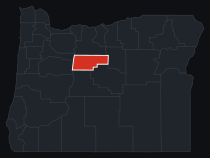
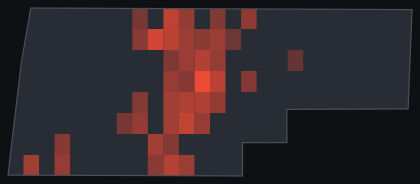
Source: U.S. Bureau of Labor Statistics, Quarterly Census of Employment and Wages, 2023 annual averages, Jefferson County. Concentration is a location quotient (county sector share of employment divided by the national share), computed by Project Red Team. Covered jobs exclude the self-employed and some agricultural workers.
Jefferson County runs on about 7,020 covered jobs across roughly 703 establishments, at an average annual wage of $51,788, and the job growth here is real: employment grew 2.9 percent over the year, ahead of most rural Oregon counties. Manufacturing is the single largest sector by headcount, at 1,258 jobs, and it runs more than twice as concentrated here as the national average, a location quotient of 2.12, built largely on the seed-cleaning and food-processing plants that turn Jefferson County's irrigated crops into a shippable product. Public administration follows close behind at 1,115 jobs and an even higher concentration, 3.2 times the national rate, a reflection of county government and the Confederated Tribes of Warm Springs' own tribal government sharing the same county. Health care and social assistance (855 jobs), retail trade (672), and accommodation and food services (633) round out the largest employers. The highest concentration of all belongs to agriculture, forestry, and fishing, at 6.16 times the national rate, the engine underneath the county's manufacturing and public-sector jobs alike.
Jefferson County's economy runs on irrigated agriculture and the seed industry built up around Madras. The North Unit Irrigation District delivers water to more than 950 farms across roughly 60,000 acres, and the county has become the country's leading source of hybrid carrot seed, an estimated 85 percent of the carrot seed grown in the United States, alongside Kentucky bluegrass and other grass seed, peppermint, garlic seed, and specialty potatoes. Central Oregon Seeds, Inc., founded in Madras in 1979, is the seed-cleaning and processing plant that turns that acreage into a product a buyer can actually ship, the kind of value-added processing a farm county needs to keep more of what it grows. The Confederated Tribes of Warm Springs run the other half of the county's economy: Indian Head Casino, the Kah-Nee-Ta Hot Springs Resort, Warm Springs Composite Products' fire-rated door manufacturing, and the tribes' own share of the Pelton Round Butte hydroelectric project are working enterprises employing people across the reservation and the county.
A new seed or food-processing plant, an irrigation-dependent farm expansion, or a tribal enterprise on the Warm Springs Reservation all turn on the same two questions: what it genuinely adds to Jefferson County's economy, and whether it pencils out under the county's real water rights, labor market, and freight costs to get product to market.
One venture stands out here: the continued build-out of Kah-Nee-Ta Hot Springs Resort, the Confederated Tribes of Warm Springs enterprise that reopened in July 2024 after a $13.1 million rebuild and nearly six years closed, restoring hot spring pools, riverside cabanas, an RV park, and a teepee village, and already employing more than 100 people in high season. The resort's own phase-two plan adds soaking tubs and food-court upgrades, and the tribes have discussed further phases beyond that: reopening the resort's nine-hole golf course, an indoor water park, a larger RV park, and an outdoor event venue. Each of those is a real capital decision the tribes will weigh with real money, and each is exactly the kind of question worth measuring honestly before it is funded: what a given phase returns in jobs and visitor spending for Warm Springs and Jefferson County, and whether it pencils out against what it costs to build and staff.
Public-data path: regional input-output multipliers, free-data regionalized or drawn from a purchased BEA RIMS II order where a project supplies one, BLS QCEW and Census LODES for the local labor base, USDA NASS and North Unit Irrigation District records for the agricultural core, and the Confederated Tribes of Warm Springs' own public enterprise reporting for the tribal economy.
We produce the study first: economic impact (what a project brings to Jefferson County, in jobs, output, and tax revenue, with local leakage handled honestly), feasibility and viability (whether it should move forward, measured with the finance a lender runs), and fiscal impact for public budgets and grant applications. Every engagement returns a full report, a one-page brief, a reviewer pack, and a decision package.
And if a study is already in hand, we review it: we inventory its quotable claims, attach the evidence, and tell you plainly what survives review before you quote it or fund against it. More on reading a study before you rely on it.
National firms fly in, bill the travel, and price a county like Jefferson out of the analysis it needs. We work across the interior West, we can be on-site in Madras or Warm Springs, and we build every study on the county's measured federal record, the same BLS and Census data behind the numbers above, so the result traces to a public source and survives scrutiny.
Have a project in Jefferson County? Tell us what you are weighing and where. We will lay out what it takes to answer it, and what it costs.
Commission a study