Independent economic studies for the governments, developers, and businesses of Oregon's high desert, built on Lake County's own federal data and designed to hold up when a lender, a regulator, or a funder reviews them.
| Largest sectors by employment | Jobs | Concentration |
|---|---|---|
| Agriculture, forestry & fishing | 459 | 21.83x |
| Public administration | 371 | 2.92x |
| Retail trade | 238 | 0.91x |
| Manufacturing | 197 | 0.91x |
| Health care & social assistance | 120 | 0.31x |

Source: U.S. Bureau of Labor Statistics, Quarterly Census of Employment and Wages, 2023 annual averages, Lake County. Concentration is a location quotient (county sector share of employment divided by the national share), computed by Project Red Team. Covered jobs exclude the self-employed and some agricultural workers.
Lake County runs on just 2,562 covered jobs across 368 establishments, at an average annual wage of $48,593, one of the smallest and most concentrated labor markets in Oregon, and one that lost jobs on net over the past year, down 0.5%. Agriculture, forestry, and fishing is the largest sector by headcount, at 459 jobs, and it is not close: the county employs people in that sector at nearly 22 times the national rate, among the highest concentrations anywhere in the state. Public administration is the second-largest sector at 371 jobs and also runs far above the national rate, at 2.92 times, the mark of a county where most of the land is federal or state ground and government work carries real weight. Retail trade, at 238 jobs, and manufacturing, at 197 jobs, sit close to the national rate. Health care, at 120 jobs, runs well below it, at less than a third the national rate, a sign of how thin services are stretched across 8,275 square miles.
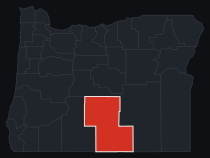
Lake County's economy runs on cattle and sheep ranching, alfalfa and hay, a timber industry that has shrunk to a single sawmill in Lakeview, and the public land that surrounds all of it: the Bureau of Land Management alone controls roughly half the county, with federal and state ownership together closer to three-quarters. Lakeview, the county seat and self-styled tallest town in Oregon at 4,804 feet, anchors what services and government employment exist in a county of roughly 8,000 people spread across more than 8,000 square miles. The newer piece is renewable energy: Lake County's open land, high solar irradiance, and reach toward major transmission corridors have drawn a wave of utility-scale solar development around Christmas Valley, layered on decades of on-and-off interest in the geothermal resources under the Warner Valley.
A ranch expansion, a sawmill investment, a solar or geothermal project, or a public infrastructure grant all turn on the same two questions here: what it actually returns to a county this sparse and this dependent on federal land and federal payroll, and whether it can survive the real conditions on the ground, a thin labor pool, distance to market, and, for energy projects especially, the transmission capacity to actually move the power out.
Utility-scale solar is the live subject in Lake County. The Obsidian Solar Center, a proposed 400-megawatt facility on roughly 4,080 acres between Fort Rock and Christmas Valley, would be among the largest solar farms in the Pacific Northwest, and Oregon's Energy Facility Siting Council has already granted and amended its site certificate, most recently extending the construction-start deadline to February 2028 while the developer waits on transmission approval from the Bonneville Power Administration. A second 400-megawatt proposal nearby, Archway Solar, was withdrawn from the state process in January 2025, with its developer saying it intends to refile. Both cases carry the same lesson: a big generation number and a signed site certificate are not the same thing as a project that can actually move its power to market, and that gap between what a facility could produce and what its interconnection allows is exactly the kind of question an honest feasibility study is built to answer, alongside the construction jobs, the temporary-versus-permanent employment (roughly 300 construction jobs against about three permanent ones at Obsidian), and the county tax revenue a completed project would return.
Public-data path: regional input-output multipliers, free-data regionalized or drawn from a purchased BEA RIMS II order where a project supplies one, BLS QCEW and Census LODES for the local labor base, USDA NASS for the ranching and hay economy, and the public site-certificate record, including acreage, capacity, and jobs figures, published by the Oregon Department of Energy's Energy Facility Siting Council for the Obsidian Solar Center and Archway Solar dockets.
We produce the study first: economic impact (what a project brings to Lake County, in jobs, output, and tax revenue, with local leakage handled honestly), feasibility and viability (whether it should move forward, measured with the finance a lender runs), and fiscal impact for public budgets and grant applications. Every engagement returns a full report, a one-page brief, a reviewer pack, and a decision package.
And if a study is already in hand, we review it: we inventory its quotable claims, attach the evidence, and tell you plainly what survives review before you quote it or fund against it. More on reading a study before you rely on it.
National firms fly in, bill the travel, and price a county as remote as Lake County out of the analysis it needs. We work across the interior West, we can be on-site in Lakeview or Christmas Valley, and we build every study on the county's measured federal record, the same BLS and Census data behind the numbers above, so the result traces to a public source and survives scrutiny.
Have a project in Lake County? Tell us what you are weighing and where. We will lay out what it takes to answer it, and what it costs.
Commission a study