Independent economic studies for the governments, developers, and businesses of the Idaho Falls area, built on Bonneville County's own federal data and designed to hold up when a lender or a funder reviews them.
| Largest sectors by employment | Jobs | Concentration |
|---|---|---|
| Health care & social assistance | 12,921 | 1.37x |
| Retail trade | 8,527 | 1.35x |
| Accommodation & food services | 6,690 | 1.18x |
| Construction | 4,393 | 1.34x |
| Educational services | 4,240 | 0.81x |
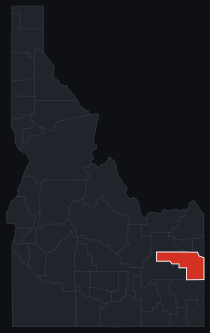
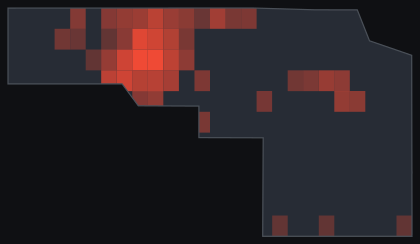
Source: U.S. Bureau of Labor Statistics, Quarterly Census of Employment and Wages, 2023 annual averages, Bonneville County. Concentration is a location quotient (county sector share of employment divided by the national share), computed by Project Red Team. Covered jobs exclude the self-employed and some agricultural workers.
Bonneville County runs on roughly 61,800 covered jobs across about 5,270 establishments, at an average annual wage near $47,700, with employment up about 3.8 percent over the year, one of the faster growth rates in this part of the state. Health care is the single largest employer at close to 13,000 jobs, followed by retail, hospitality, and construction. The concentrations point to a regional hub still expanding: health care runs at about 1.4 times the national rate, retail and construction at roughly 1.3 times, and wholesale trade at about 1.3 times, the profile of a city that supplies goods, care, and services across a wide stretch of eastern Idaho.
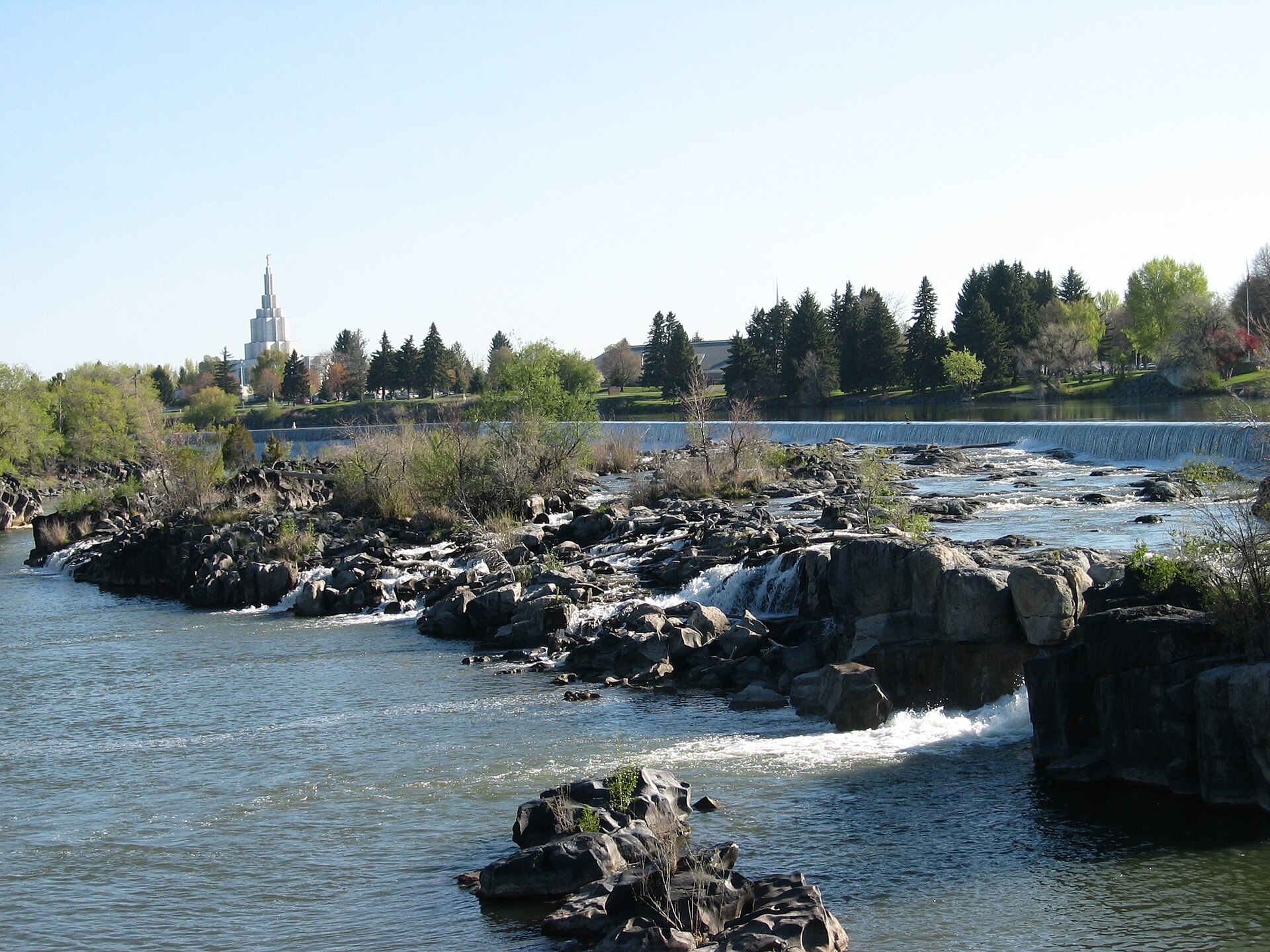
Bonneville County is the commercial hub of eastern Idaho. Idaho Falls anchors a health care, retail, and professional-services economy that reaches well beyond the county line, and much of the region's technical workforce is tied to Idaho National Laboratory, the federal nuclear-energy research complex on the desert to the west whose employees and contractors live and spend across the Idaho Falls area. Agriculture on the surrounding Snake River Plain feeds a food and farm-supply economy underneath the service base.
A new hospital wing, a research or engineering supplier tied to the national laboratory, a data center drawing on the region's power, or a housing development for a growing workforce all turn on the same questions: what the project genuinely adds to the county, how much would have happened anyway, and whether it pencils under eastern Idaho's real conditions.
The live subject a study here has to reckon with is the wave of advanced nuclear activity centered on Idaho National Laboratory, where the federal government and private developers are testing and building a new generation of reactors, with demonstration projects breaking ground and proposals to pair small reactors with power-hungry data centers. Because most of that workforce and its spending land in the Idaho Falls area, the construction, the specialized hiring, and the supplier growth are all real economic effects the county and its partners will want measured honestly, separating durable operating activity from one-time construction and separating genuinely new demand from activity the region would have seen anyway. That is exactly the kind of question the engine is built to answer.
Public-data path: regional input-output multipliers, free-data regionalized or drawn from a purchased BEA RIMS II order where a project supplies one, BLS QCEW and Census LODES for the local labor base, USDA NASS for the surrounding agricultural economy, and the public Department of Energy and contractor figures where a national-laboratory project puts real spending on the record.
We produce the study first: economic impact (what a project brings to Bonneville County, in jobs, output, and tax revenue, with local leakage handled honestly), feasibility and viability (whether it should move forward, measured with the finance a lender runs), and fiscal impact for public budgets and grant applications. Every engagement returns a full report, a one-page brief, a reviewer pack, and a decision package.
And if a study is already in hand, we review it: we inventory its quotable claims, attach the evidence, and tell you plainly what survives review before you quote it or fund against it. More on reading a study before you rely on it.
National firms fly in, bill the travel, and price a county like Bonneville out of the analysis it needs. We work across the interior West, we can be on-site, and we build every study on the county's measured federal record, the same BLS and Census data behind the numbers above, so the result traces to a public source and survives scrutiny.
Have a project in Bonneville County? Tell us what you are weighing and where. We will lay out what it takes to answer it, and what it costs.
Commission a study