Independent economic studies for the governments, developers, and businesses of the Nampa and Caldwell area, built on Canyon County's own federal data and designed to hold up when a lender or a funder reviews them.
| Largest sectors by employment | Jobs | Concentration |
|---|---|---|
| Manufacturing | 11,080 | 1.53x |
| Construction | 10,748 | 2.37x |
| Health care & social assistance | 10,728 | 0.82x |
| Retail trade | 9,783 | 1.12x |
| Educational services | 7,145 | 0.99x |
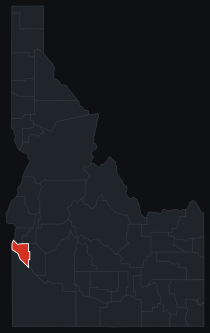
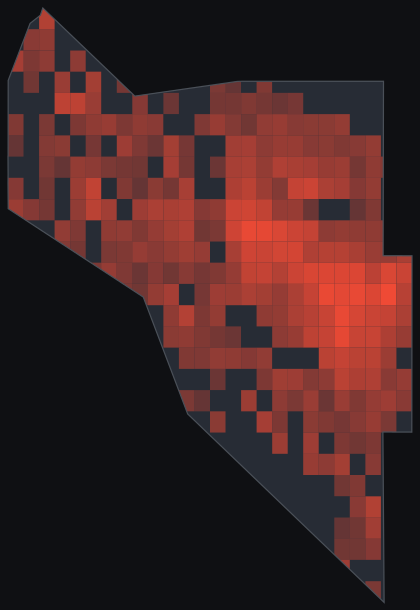
Source: U.S. Bureau of Labor Statistics, Quarterly Census of Employment and Wages, 2023 annual averages, Canyon County. Concentration is a location quotient (county sector share of employment divided by the national share), computed by Project Red Team. Covered jobs exclude the self-employed and some agricultural workers.
Canyon County runs on roughly 85,600 covered jobs across about 8,100 establishments, at an average annual wage near $49,500. Manufacturing leads the headcount at close to 11,100 jobs, just ahead of construction and health care, an unusual industrial base for a county this size. The real story is in the concentration: agriculture, forestry, and fishing employ people here at more than four and a half times the national rate, construction at more than twice, and transportation and warehousing at about 1.7 times. That combination, farms and food plants feeding warehouses and trucks, is the engine underneath the county, and it is why a project here lives or dies on land, water, and how cheaply output can be processed and moved.
Canyon County is the agricultural and industrial half of the Treasure Valley. Nampa and Caldwell anchor a working economy of food processing, sugar and dairy operations, farm supply, and the distribution and manufacturing that have followed the interstate and the rail line west from Boise. The Amalgamated Sugar plant in Nampa and a dense base of food and beverage processors sit on top of some of the most productive irrigated farmland in Idaho, while the county absorbs a growing share of the valley's population and warehousing.
A new food-processing line, a dairy expansion, a distribution center, or a subdivision on former farmland all turn on the same two questions: what the project genuinely returns to the county, and whether it pencils under the valley's real land, labor, and water conditions.
The live subject a study here has to reckon with is the continued buildout of food processing and logistics around Nampa and Caldwell, from long-standing anchors like the Amalgamated Sugar factory to the wave of warehouse, cold-storage, and data-center development filling the county's industrial parks. A project like a new processing line or a large distribution facility brings real construction spending, direct hiring, and demand for local crops and services, and the county and its partners will want those effects measured honestly, separating genuinely new activity from growth the valley would have absorbed anyway and separating one-time construction from the durable operating economy. That is exactly the kind of question the engine is built to answer.
Public-data path: regional input-output multipliers, free-data regionalized or drawn from a purchased BEA RIMS II order where a project supplies one, BLS QCEW and Census LODES for the local labor base, USDA NASS for the county's crop and dairy economy, and Census building-permit and population data for the valley's growth.
We produce the study first: economic impact (what a project brings to Canyon County, in jobs, output, and tax revenue, with local leakage handled honestly), feasibility and viability (whether it should move forward, measured with the finance a lender runs), and fiscal impact for public budgets and grant applications. Every engagement returns a full report, a one-page brief, a reviewer pack, and a decision package.
And if a study is already in hand, we review it: we inventory its quotable claims, attach the evidence, and tell you plainly what survives review before you quote it or fund against it. More on reading a study before you rely on it.
National firms fly in, bill the travel, and price a county like Canyon out of the analysis it needs. We work across the interior West, we can be on-site, and we build every study on the county's measured federal record, the same BLS and Census data behind the numbers above, so the result traces to a public source and survives scrutiny.
Have a project in Canyon County? Tell us what you are weighing and where. We will lay out what it takes to answer it, and what it costs.
Commission a study