Independent economic studies for the governments, developers, and businesses of Klickitat County, built on the county's own federal data and designed to hold up when a lender, a council, or a funder reviews them.
| Largest sectors by employment | Jobs | Concentration |
|---|---|---|
| Manufacturing | 1,206 | 2.05x |
| Health care & social assistance | 849 | 0.8x |
| Educational services | 658 | 1.12x |
| Public administration | 480 | 1.39x |
| Retail trade | 450 | 0.63x |
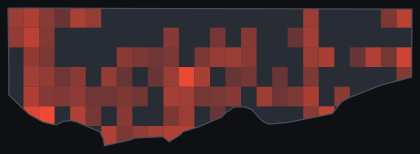
Source: U.S. Bureau of Labor Statistics, Quarterly Census of Employment and Wages, 2023 annual averages, Klickitat County. Concentration is a location quotient (county sector share of employment divided by the national share), computed by Project Red Team. Covered jobs exclude the self-employed and some agricultural workers.
Klickitat County runs on roughly 6,960 covered jobs across about 790 establishments, at an average annual wage near $60,300, a figure that sits above what most rural counties in the interior can pay and reflects the industrial and utility work along the Columbia. Manufacturing is the largest employer at about 1,200 jobs, followed by health care, education, public administration, and retail, the ordinary spine of the towns from Goldendale to White Salmon. The concentration tells the sharper story: manufacturing employs people here at roughly twice the national rate, and utilities run about half again the national share, a legacy of the aluminum era and the power that moves through the Gorge. Covered jobs slipped about 3.9 percent over the year, the kind of swing a study has to explain before anyone reads a projection built on top of it.
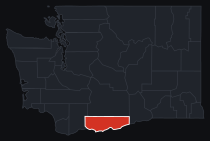
Klickitat County sits on the Washington side of the Columbia River Gorge, where energy, agriculture, and a thin band of manufacturing carry the weight. Goldendale anchors the county seat, its government, and the old aluminum-smelter site that now draws energy developers. White Salmon and Bingen hold the wetter western end, with orchards, small wineries, and outdoor recreation, while Maryhill marks the point where US Highway 97 crosses the river toward Oregon. Wind turbines line the ridges, wheat and cattle work the dry plateau, and the Yakama Nation's ceded lands and cultural sites run through the county's north and west.
A wind or storage project on the ridgeline, a food or wood processor near Goldendale, an orchard or ranch expansion, or a downtown reinvestment in White Salmon all turn on the same two questions: what the project genuinely returns to the county, and whether it pencils under local wages, land, and transmission constraints.
The live subject a study here almost has to reckon with is the Goldendale Energy Storage Project, the roughly 2 billion dollar pumped-storage plant that received a 40-year federal license in January 2026 and would move water between two reservoirs on the site of the former aluminum smelter southeast of Goldendale. Backers describe a construction workforce in the thousands over four to five years, a few dozen permanent jobs, and on the order of 10 million dollars a year in county revenue once it runs. The project is also contested, because the site sits on land the Yakama Nation holds sacred, and that opposition is part of the real picture. An honest study would separate the one-time construction spike from the durable jobs and tax base that follow, and weigh the local benefit against the cultural and environmental costs the county will have to account for.
Public-data path: regional input-output multipliers, free-data regionalized or drawn from a purchased BEA RIMS II order where a project supplies one, BLS QCEW and Census LODES for the local labor base, USDA NASS for the orchard and dryland-farming core, and the public licensing and cost record filed with the Federal Energy Regulatory Commission for energy projects like Goldendale.
We produce the study first: economic impact (what a project brings to Klickitat County, in jobs, output, and tax revenue, with local leakage handled honestly), feasibility and viability (whether it should move forward, measured with the finance a lender runs), and fiscal impact for public budgets and grant applications. Every engagement returns a full report, a one-page brief, a reviewer pack, and a decision package.
And if a study is already in hand, we review it: we inventory its quotable claims, attach the evidence, and tell you plainly what survives review before you quote it or fund against it. More on reading a study before you rely on it.
National firms fly in, bill the travel, and price a county like Klickitat out of the analysis it needs. We work across the interior West, we can be on-site, and we build every study on the county's measured federal record, the same BLS and Census data behind the numbers above, so the result traces to a public source and survives scrutiny.
Have a project in Klickitat County? Tell us what you are weighing and where. We will lay out what it takes to answer it, and what it costs.
Commission a study