
Independent economic studies for the governments, developers, and businesses of Lassen County, built on the county's own federal data and designed to hold up when a lender, a state agency, or a funder reviews them.
| Largest sectors by employment | Jobs | Concentration |
|---|---|---|
| Public administration | 3,956 | 8.84x |
| Health care & social assistance | 1,140 | 0.83x |
| Educational services | 916 | 1.2x |
| Retail trade | 862 | 0.94x |
| Accommodation & food services | 590 | 0.71x |
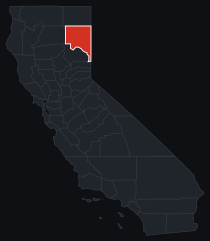
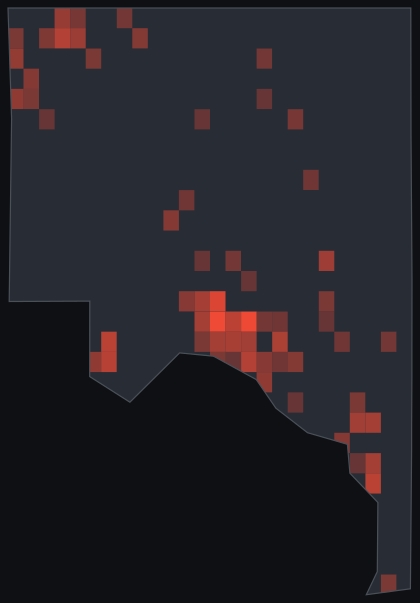
Source: U.S. Bureau of Labor Statistics, Quarterly Census of Employment and Wages, 2023 annual averages, Lassen County. Concentration is a location quotient (county sector share of employment divided by the national share), computed by Project Red Team. Covered jobs exclude the self-employed and some agricultural workers.
Lassen County runs on roughly 9,025 covered jobs across 752 establishments, at an average annual wage of $57,550, and the job count fell 2.7 percent over the year, one of the sharper declines in the region. Public administration dominates the county's job base: 3,956 jobs, close to 44 percent of every covered job in the county, at a location quotient of 8.84, meaning the county employs people in public administration at nearly nine times the national rate. Health care and social assistance (1,140 jobs), educational services (916), retail trade (862), and accommodation and food services (590) round out the next tier, an ordinary small-county service base sitting underneath an extraordinary public-sector core. Agriculture, forestry, and fishing does not crack the top five by headcount, but runs at 5.1 times the national concentration, and utilities at 1.7 times, both real threads in a county whose center of gravity is still, by a wide margin, government work.
Lassen County's economy is a prison economy, and the federal data leaves no room to read it any other way. Public administration accounts for 3,956 of the county's 9,025 covered jobs, a location quotient of 8.84 that ranks among the highest concentrations found in any county in the country, and it traces to correctional facilities packed into one small county: High Desert State Prison and, until recently, the California Correctional Center, both run by the state, plus the federal Bureau of Prisons' FCI Herlong. For six decades the two state prisons plus Herlong were among the steadiest paychecks in the county, feeding retail, housing, and the Susanville school district even when the ranching and timber economy around them tightened.
That premise broke on June 30, 2023, when CDCR shut down the California Correctional Center for good, a 60-year-old facility the state had determined would need $503 million in repairs to keep running, eliminating roughly 1,080 staff positions from a county payroll of nine thousand jobs. Susanville and Lassen County sued to stop it under the California Environmental Quality Act, arguing the state had never accounted for what the closure would do to the local economy, and the courts let the closure proceed anyway. Outside the prison economy, the county still runs on cattle ranching in the Honey Lake Valley, timber off the Lassen and Plumas National Forests, and the roughly one million acres the BLM's Eagle Lake Field Office manages for grazing, timber, and recreation, real industries but none of them able to absorb a thousand lost public-sector jobs on their own.
The subject worth measuring here is the CCC closure itself, and it measures something most of what this practice studies does not: what an actual, already-executed closure took away, and whether CDCR's projected $122 million in annual statewide savings holds up against what Lassen County and the city of Susanville actually lost. The county's covered jobs were already down 2.7 percent for 2023, the year CCC shut its gates, and an honest fiscal and economic impact study would isolate how much of that decline is the roughly 1,080 CCC positions eliminated or transferred, how much High Desert State Prison and FCI Herlong absorbed, and what it means for Susanville's retail base, its housing market, and the local school district's enrollment and funding, the same question the county and the city tried and failed to force the state to answer in court before the prison closed.
Public-data path: BLS QCEW for the local job and wage base, CDCR's public closure notices and cost-savings estimates for the California Correctional Center, Lassen County and City of Susanville budget and CEQA filings from the closure litigation, BLM Public Land Statistics for the Eagle Lake Field Office's grazing and timber acreage, and USDA NASS for the ranching economy.
We produce the study first: economic impact (what a project brings to Lassen County, in jobs, output, and tax revenue, with local leakage handled honestly), feasibility and viability (whether it should move forward, measured with the finance a lender runs), and fiscal impact for public budgets and grant applications. Every engagement returns a full report, a one-page brief, a reviewer pack, and a decision package.
And if a study is already in hand, we review it: we inventory its quotable claims, attach the evidence, and tell you plainly what survives review before you quote it or fund against it. More on reading a study before you rely on it.
National firms fly in, bill the travel, and price a county like Lassen out of the analysis it needs, especially on a question the state itself never had to defend in court. We work across the interior West, we can be on-site in Susanville, and we build every study on the county's measured federal record, the same BLS and CDCR data behind the numbers above, so the result traces to a public source and survives scrutiny from either side of the table.
Have a project in Lassen County? Tell us what you are weighing and where. We will lay out what it takes to answer it, and what it costs.
Commission a study