Independent economic studies for the governments, developers, and businesses of Plumas County, built on the county's own federal data and designed to hold up when a lender, a funder, or a state disaster-recovery office reviews them.
| Largest sectors by employment | Jobs | Concentration |
|---|---|---|
| Health care & social assistance | 1,214 | 1.25x |
| Public administration | 815 | 2.58x |
| Educational services | 639 | 1.19x |
| Accommodation & food services | 615 | 1.05x |
| Retail trade | 614 | 0.95x |
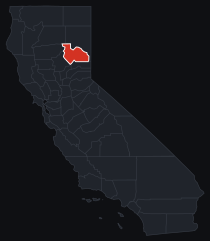
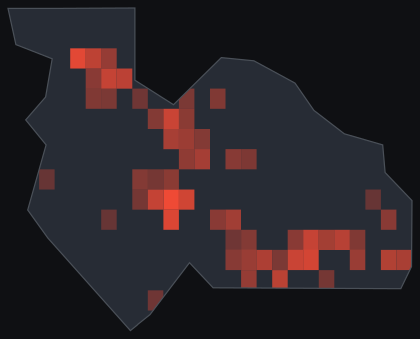
Source: U.S. Bureau of Labor Statistics, Quarterly Census of Employment and Wages, 2023 annual averages, Plumas County. Concentration is a location quotient (county sector share of employment divided by the national share), computed by Project Red Team. Covered jobs exclude the self-employed and some agricultural workers.
Plumas County runs on roughly 6,371 covered jobs across 948 establishments, at an average annual wage of $57,223, well below both the state and national averages, in a county small enough that a single sector can move the whole record. Job growth was modest over the year, up 1.3 percent. Health care and social assistance (1,214 jobs) is the largest employer by headcount, followed by public administration (815), educational services (639), accommodation and food services (615), and retail trade (614), the ordinary spine of a rural county seat. The real story sits in concentration: utilities employs only 212 people here, a small number on its own, but at 6.08 times the national rate it is by far the sharpest specialization in the county, and it traces directly to the hydroelectric dams and powerhouses PG&E built and still runs on the North Fork Feather River, the Rock Creek, Cresta, and Belden plants, the Bucks Creek project, and the Lake Almanor reservoir behind Canyon Dam. Public administration also runs at 2.58 times the national rate, arts, entertainment, and recreation at 1.88 times, and other services at 1.45 times.
Plumas County's economy has three real layers. The oldest is timber, the sawmills and wood products cut from the Sierra forests that cover most of the county's roughly 2,600 square miles. Built on top of that, across the twentieth century, is the hydroelectric system PG&E developed on the North Fork Feather River: the Rock Creek and Cresta powerhouses and the Belden plant strung through the Feather River Canyon, the Bucks Creek project, and Lake Almanor itself, impounded behind Canyon Dam to feed the whole chain. That build-out still runs on a small, well-paid utility workforce, and it is why a county of under 20,000 people carries a utilities concentration higher than anywhere else in California. Tourism and recreation are the third layer: Lake Almanor's shoreline, Bucks Lake, the Feather River Canyon, and the surrounding Plumas National Forest draw campers, anglers, and boaters every summer, and Quincy, the county seat, carries the government offices, the hospital, and the Feather River College campus that a rural county this size depends on for everything else.
Since August 2021 the county has also carried a layer it never asked for. The Dixie Fire, traced by investigators to a tree that came into contact with PG&E distribution equipment in the Feather River Canyon near the Cresta powerhouse, grew into the largest single-ignition wildfire in California's recorded history at just under a million acres, and it burned through the town of Greenville, destroying most of its downtown, along with parts of Canyon Dam, Indian Falls, and Warner Valley. Rebuilding Greenville, replacing the housing stock the fire took, and treating the burn scar for the timber and watershed effects that follow a fire that size are now working economic questions in Plumas County alongside the older ones. A new mill investment, a hydro relicensing or maintenance project, a Lake Almanor recreation venture, or the next phase of the Greenville rebuild all face the same test: what it actually returns to a county this small, and whether it pencils given the labor and housing constraints of a place still rebuilding five years on.
The live case in the county is the continuing recovery from the Dixie Fire, specifically the Greenville rebuild and the housing and forest-treatment spending still working through the county five years after the fire. That spending draws on a mix of sources: CDBG-DR and other federal disaster-recovery grants, USDA Rural Development housing funds, Cal OES and state wildfire-recovery dollars, and the settlement and subrogation payments PG&E has made and continues to make for damage tied to its equipment. The Sierra Institute for Community and Environment, headquartered in the county, has led much of the forest-resilience and biomass-utilization side of that work. What a county, a school district, or a state agency needs here is the same discipline any capital project gets: separate the one-time reconstruction spike, much of it federal and insurance money passing through the local economy once, from the durable jobs and tax base that survive once the rebuild is finished, and be plain about which projects actually restore what the fire took.
Public-data path: regional input-output multipliers, free-data regionalized or drawn from a purchased BEA RIMS II order where a project supplies one, BLS QCEW and Census LODES for the local labor base, USDA Forest Service and CAL FIRE data on the Dixie Fire perimeter and forest conditions, FEMA and Cal OES public disaster-recovery spending records, and PG&E's own reported wildfire settlement and rebuild-fund disbursements.
We produce the study first: economic impact (what a project brings to Plumas County, in jobs, output, and tax revenue, with local leakage handled honestly), feasibility and viability (whether it should move forward, measured with the finance a lender runs), and fiscal impact for public budgets and grant applications. Every engagement returns a full report, a one-page brief, a reviewer pack, and a decision package.
And if a study is already in hand, we review it: we inventory its quotable claims, attach the evidence, and tell you plainly what survives review before you quote it or fund against it. More on reading a study before you rely on it.
National firms fly in, bill the travel, and price a county like Plumas out of the analysis it needs, even against disaster-recovery grant deadlines that a big-city consultant's schedule cannot always meet. We work across the interior West, we can be on-site in Quincy or Greenville, and we build every study on the county's measured federal record, the same BLS and Census data behind the numbers above, so the result traces to a public source and survives scrutiny from a funder, a lender, or a county board.
Have a project in Plumas County? Tell us what you are weighing and where. We will lay out what it takes to answer it, and what it costs.
Commission a study