Independent economic studies for the governments, developers, and businesses of Tehama County, built on the county's own federal data and designed to hold up when a lender, a grower, or a funder reviews them.
| Largest sectors by employment | Jobs | Concentration |
|---|---|---|
| Health care & social assistance | 3,383 | 1.12x |
| Retail trade | 2,132 | 1.06x |
| Educational services | 1,967 | 1.18x |
| Manufacturing | 1,825 | 1.09x |
| Transportation & warehousing | 1,762 | 1.84x |
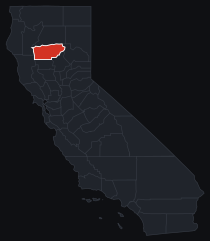
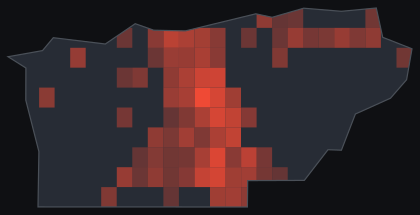
Source: U.S. Bureau of Labor Statistics, Quarterly Census of Employment and Wages, 2023 annual averages, Tehama County. Concentration is a location quotient (county sector share of employment divided by the national share), computed by Project Red Team. Covered jobs exclude the self-employed and some agricultural workers.
Tehama County runs on roughly 19,801 covered jobs across 2,104 establishments, at an average annual wage of $55,521, well below the state and national figures, with job growth flat but positive over the year at 1.4 percent. Health care and social assistance is the largest employer by headcount at 3,383 jobs (LQ 1.12), followed by retail trade at 2,132 (LQ 1.06), educational services at 1,967 (LQ 1.18), manufacturing at 1,825 (LQ 1.09), and transportation and warehousing at 1,762 (LQ 1.84), the ordinary spine of a county seat serving a wide rural area. The real story sits in concentration: arts, entertainment, and recreation runs at 2.24 times the national rate, the single highest specialization in the county, transportation and warehousing runs at 1.84 times, public administration at 1.52 times, and utilities at 1.37 times. That mix, heavy trucking and warehousing sitting alongside an outsized entertainment and recreation sector, traces to Interstate 5 running the full length of the county and to Rolling Hills Casino outside Corning, and it means a project here gets judged against a real, mixed economic base rather than the single-crop story the county's reputation suggests.
Tehama County's economy still starts in the ground. Corning calls itself the Olive Capital of the World, and the claim has weight behind it: Bell-Carter Foods, the largest table olive processor in the United States and maker of the Lindsay brand, has run its packing and processing plant in Corning since 1980, buying from more than 80 growers across roughly 3,000 acres of olives in Tehama and Tulare counties. Almonds and walnuts have grown alongside the olives and, as of the county's own 2024 crop report, now outrank them, with almonds the single largest crop at nearly $116 million and total gross agricultural production across the county topping $407 million. Cattle country runs underneath all of it, most visibly each winter at the Red Bluff Bull and Gelding Sale, a livestock auction running since 1941 that draws roughly 30,000 people and ranks among the largest of its kind west of the Rockies. Red Bluff itself carries the county's health care, retail, and services base, anchored by Dignity Health's St. Elizabeth Community Hospital, while Interstate 5 running through Red Bluff, Corning, and Los Molinos gives the county a real distribution and trucking economy on top of the farm one, and the Paskenta Band of Nomlaki Indians' Rolling Hills Casino and Resort outside Corning has grown into one of the county's three largest employers.
A processing plant expansion, a new orchard or ranch operation, a distribution facility off the interstate, or a hospital or tribal enterprise project here all face the same test: what it actually returns to the county in jobs, payroll, and local purchasing, set plainly against the investment or the public commitment it asks for, built on the same federal data behind the numbers above rather than the boosterism a press release usually leads with.
The live, citable case is the modernization underway at Bell-Carter's Corning plant. Spain's Aceitunas Guadalquivir, led by the Escalante family, acquired Bell-Carter Foods in 2022 and committed to immediate upgrades at the Corning facility, including updated olive cookers, expanded warehouse space, and new production lines, while keeping the roughly 300-person workforce and the company's 80-plus-grower supply base in Tehama and Tulare counties intact. That is a real economic-impact question with public facts behind it: what the retained payroll and grower contracts are worth to the county on their own, what the capital investment itself adds during construction, and what the expanded processing and warehouse capacity is worth going forward, separated cleanly from the jobs that were already there before new ownership walked in the door.
Public-data path: BLS QCEW for the local job and wage base, USDA NASS and the Tehama County Agricultural Commissioner's annual crop report for the olive, almond, walnut, and cattle economy, HCAI and Dignity Health community benefit filings for the hospital base, and the public reporting on the Bell-Carter Foods and Aceitunas Guadalquivir transaction for the processing-plant investment.
We produce the study first: economic impact (what a project brings to Tehama County, in jobs, output, and tax revenue, with local leakage handled honestly), feasibility and viability (whether it should move forward, measured with the finance a lender runs), and fiscal impact for public budgets and grant applications. Every engagement returns a full report, a one-page brief, a reviewer pack, and a decision package.
And if a study is already in hand, we review it: we inventory its quotable claims, attach the evidence, and tell you plainly what survives review before you quote it or fund against it. More on reading a study before you rely on it.
National firms fly in, bill the travel, and price a county like Tehama out of the analysis it needs, even though the plant, the ranch, or the distribution deal in question is worth real money to a grower network or a workforce that lives here year round. We work across the interior West, we can be on-site in Red Bluff or Corning, and we build every study on the county's measured federal record, the same BLS, USDA, and hospital data behind the numbers above, so the result traces to a public source and survives scrutiny.
Have a project in Tehama County? Tell us what you are weighing and where. We will lay out what it takes to answer it, and what it costs.
Commission a study